
A Fully Detailed Book
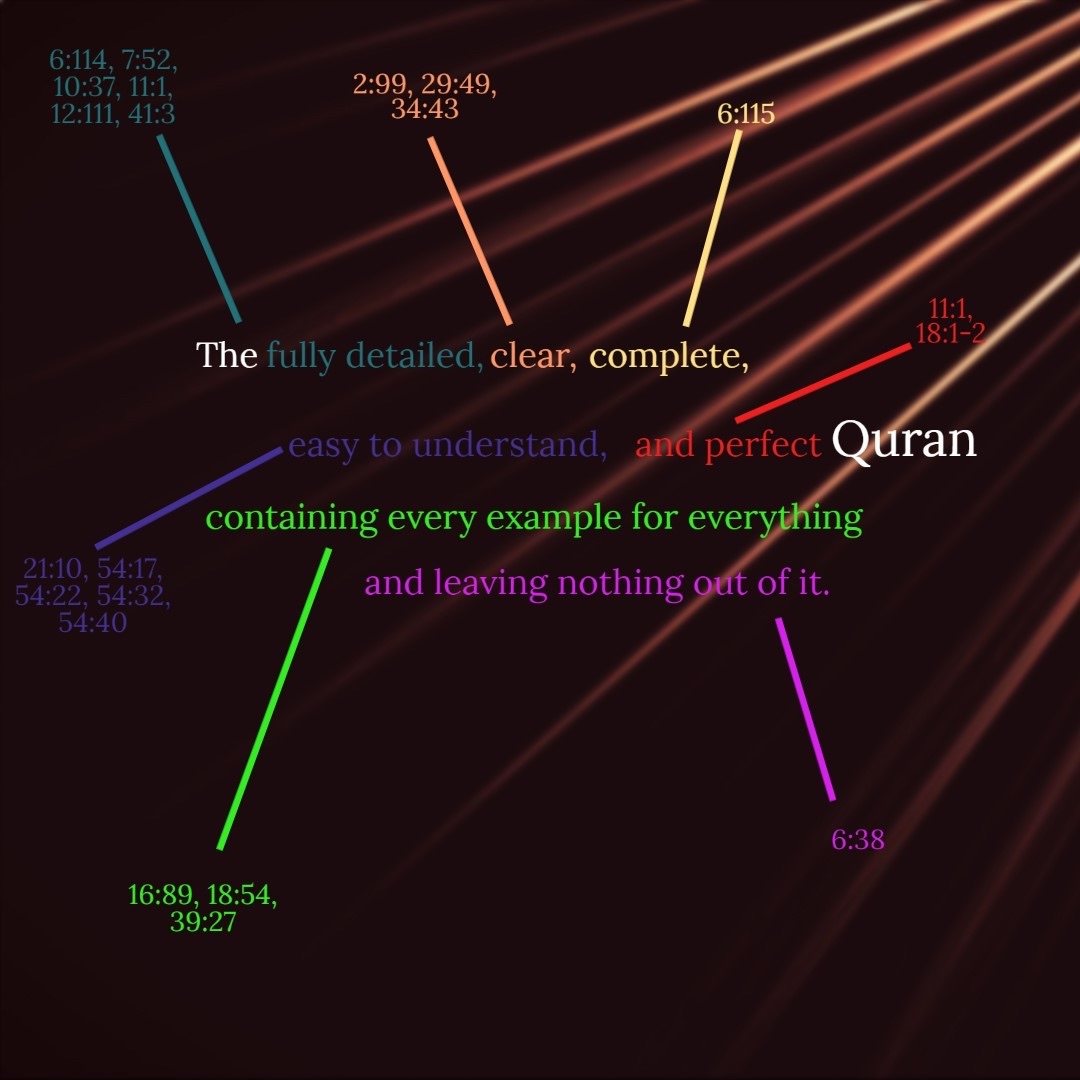
Every Muslim will readily affirm that the Quran is the word of God. That affirmation is where agreement tends to end. Because genuine belief in the Quran requires not one conviction but six - and it is on the remaining five that the majority of Muslims, shaped by centuries of scholarly tradition, fall decisively short.
The six attributes that authentic belief in the Quran demands are these:
- The Quran is the word of God.
- The Quran is perfect, with no contradictions.
- The Quran is clear, with no ambiguity.
- The Quran is straightforward, with no crookedness.
- The Quran is complete.
- The Quran is fully detailed.
To affirm the first while effectively denying the others is not belief in the Quran. It is belief in a version of the Quran filtered through human additions, scholarly restrictions, and institutional authority - a version the Book itself consistently and explicitly rejects. What follows examines each attribute in turn.
First: The Quran Is the Word of God
[6:155-157] This too is a blessed scripture that we have revealed; you shall follow it and lead a righteous life, that you may attain mercy. Now you can no longer say, "The scripture was sent down to two groups before us, and we were unaware of their teachings." Nor can you say, "If only a scripture could come down to us, we would be better guided than they." A proven scripture has now come to you from your Lord, and a beacon, and a mercy. Now, who is more evil than one who rejects these proofs from GOD, and disregards them? We will commit those who disregard our proofs to the worst retribution for their heedlessness.
The proof referred to in 6:157 is not merely the eloquence of the text or the nobility of its message. It is the mathematical structure embedded in the Quran - the code built on the number 19, woven through the Book's construction at the level of its letters, words, verses, and chapters in a way that no human author, working alone or in collaboration, could have engineered while simultaneously producing a coherent and comprehensive religious text. This structure was not discovered until 1974, but it was announced in the Book itself fourteen centuries earlier (74:30-35). It is the physical, verifiable proof that the Quran is not the work of any human being.
For detailed information regarding this specifically, please see: A Perpetual Miracle
Second: The Quran Is Perfect, with No Contradictions
[11:1] A.L.R. This is a scripture whose verses have been perfected, then elucidated. It comes from a Most Wise, Most Cognizant.
No verse of the Quran contradicts or invalidates another. This is not a claim requiring qualification - it is a statement about the nature of the Book that the Book makes about itself. Yet a significant body of Muslim scholarship has spent centuries arguing the opposite, through the doctrine of Al-Nasekh and Al-Mansoukh - the abrogator and the abrogated - which claims that certain Quranic verses cancel out other Quranic verses.
This doctrine is a lie against the Book. It was invented not to serve the Quran but to serve the hadith - to create the impression that a book containing internal contradictions can still be divine, thereby legitimizing the contradiction-riddled hadith collections by parallel. The Quran's own response to this maneuver is direct:
[10:64] Good news awaits them in this life, and in the Hereafter. Such is GOD's unchangeable law. This is the greatest triumph.
Words that cannot be altered cannot be abrogated. The doctrine of abrogation contradicts the Quran's explicit self-description and must be rejected entirely.
For detailed information regarding this specifically, please see: False Accusations
Third: The Quran Is Clear, with No Ambiguity
[12:1] A.L.R. These are the signs of the clear scripture.
[44:58] We have made it easy in your language, perhaps they will take heed.
God describes His Book as clear and easy to understand. The scholarly establishment describes it as complex, esoteric, and requiring specialized training to interpret. Both cannot be true - and the Quran's own testimony takes precedence over the scholars'.
The claim that the Quran is difficult serves a specific purpose: it creates a dependency. If ordinary believers cannot understand the Quran without scholarly mediation, they must defer to scholars on every question of religious practice. The scholars become gatekeepers to God's own law. This arrangement is the precise inversion of what God established:
[55:1-2] The Most Gracious. Teacher of the Quran.
[75:19] Then it is We who will explain it.
God teaches the Quran. God explains it. No institution of human learning stands between the sincere believer and the Book.
The Quran contains five types of verses: law-giving verses that prescribe obligations and prohibitions; warning verses that address sin and its consequences; narrative verses recounting the stories of previous peoples and prophets; informative verses containing knowledge of the natural world; and reflective verses presenting parables for contemplation. Believers will be held accountable on the Day of Judgment to the first two categories. It would be a fundamental injustice for God to make those verses opaque or ambiguous:
[4:40] GOD does not commit an atom's weight of injustice. On the contrary, He multiplies the reward of righteous works manifold. He then provides from His own bounty a great recompense.
The law-giving verses are clear for precisely this reason. The ablution verse is a perfect example:
[5:6] O you who believe, when you observe the Contact Prayers (Salat), you shall: (1) wash your faces, (2) wash your arms to the elbows, (3) wipe your heads, and (4) wash your feet to the ankles.
Four steps, stated in plain language, admitting no ambiguity. This is the register of the law-giving verses throughout the Quran. They do not require a scholar's interpolation - they require only a reader willing to take God's words at face value.
The Quran does acknowledge in 3:7 that some verses allow multiple meanings. These are not the law-giving verses. They are a distinct category - and the verse that identifies them also identifies the character of those who pursue them inappropriately: those who harbour deviation in their hearts, seeking discord and misinterpretation. The law-giving verses that constitute the foundation of the Book are placed in the same verse in explicit contrast: clear-cut, foundational, straightforward.
Fourth: The Quran Is Straightforward, with No Crookedness
[39:28] An Arabic Quran, without any ambiguity, that they may be righteous.
Those who twist God's words - claiming they mean something other than what they plainly say - are denying this fourth attribute directly. One of the most consequential examples involves Hajj:
[2:197] Hajj shall be observed in the specified months. Whoever sets out to observe Hajj shall refrain from sexual intercourse, misconduct, and arguments throughout Hajj.
The words are unambiguous. God decreed four months for Hajj - the four sacred months identified in 9:36. The Arabic farada feehinna means "executes it in them" - performs the obligatory act during those months, any time within them. Yet centuries of Islamic practice have restricted Hajj to ten days in a single month, in compliance with hadith that override the Quranic text.
The consequence is not merely theological. The restriction to ten days has made it practically impossible for the vast majority of the world's Muslims to perform Hajj in their lifetimes, while God's own law holds four months open. A generous divine concession has been quietly revoked - not by God, but by those claiming to speak on His behalf. This is what it means to introduce crookedness into a Book that has none.
For detailed information and examples regarding this topic, please see: Misinterpreted Verses
Fifth: The Quran Is Complete
[6:115] The word of your Lord is complete, in truth and justice. Nothing shall abrogate His words. He is the Hearer, the Omniscient.
The Quran is complete. No revelation from God to Muhammad exists outside it. This directly refutes the concept of hadith qudsi - the claim that God communicated additional divine speech to the prophet beyond the Quran, preserved in hadith collections. God Himself warned the prophet in the strongest possible terms against attributing to God anything beyond what was revealed:
[17:73] They almost diverted you from our revelations to you. They wanted you to fabricate something else, in order to consider you a friend.
[69:44-46] Had he uttered any other teachings. We would have punished him severely. We would have stopped the revelations to him.
The severity of these warnings establishes beyond any question that the only revelation received by Muhammad from God was the Quran. This is confirmed throughout the Book (4:105, 5:48, 6:19, 6:92, 6:155, 16:89, 29:47, 39:2, 76:23). Any claim that God's communication to His prophet extended beyond the Quran contradicts the Quran's explicit testimony about itself.
Sixth: The Quran Is Fully Detailed
[6:38] We did not leave anything out of this book.
[6:114] Shall I seek other than GOD as a source of law, when He has revealed to you this book fully detailed?
[12:111] This is not fabricated Hadith; this (Quran) confirms all previous scriptures, provides the details of everything, and is a beacon and mercy for those who believe.
[16:89] We have revealed to you this book to provide explanations for everything, and guidance and mercy and good news for the submitters.
"Fully detailed." "Details of everything." "Explanations for everything." God uses these phrases not once but repeatedly, across multiple Suras, in language that admits no qualification. Yet the dominant position in Islamic scholarship is that the Quran contains only the broad outlines of the religion and that the details are found only in the hadith and Sunna.
This position requires believing that God repeatedly described His Book as fully detailed while knowing it was not. It requires accepting that God's own description of His Book is misleading. No sincere believer can hold this position once it is stated plainly.
The fully detailed attribute must be understood in relation to the Quran's defined function: to provide the complete guidance necessary for salvation. The Quran does not contain cooking recipes or engineering specifications - it was never claimed to. But within the scope of its function - all the law, guidance, and knowledge a human being needs to worship God correctly and attain salvation - it is complete and it is detailed. Nothing required for that purpose has been left out. Nothing needs to be supplied from outside it.
Conclusion
Belief in the Quran is not satisfied by the declaration that it is the word of God. That declaration, held alongside the denial of the Book's other attributes, is not genuine belief - it is selective endorsement, accepting the parts that affirm God's authority while quietly rejecting the parts that limit human authority.
To believe the Quran is to believe that it is perfect and free of contradiction - which means rejecting the abrogation doctrine. It is to believe that it is clear and accessible - which means rejecting the scholarly monopoly on interpretation. It is to believe that it is straightforward - which means taking its law-giving verses at their word rather than twisting them to accommodate hadith. It is to believe that it is complete - which means rejecting the concept of divine speech outside the Quran. And it is to believe that it is fully detailed - which means trusting that God provided everything necessary for salvation within the Book He described as containing everything necessary for salvation.
All six attributes stand or fall together. A person who accepts the first and rejects the others has not believed the Quran. They have believed in a Book they reserve the right to supplement, restrict, and reinterpret - which is to say, they have placed their own judgment, or their scholars' judgment, above God's own words. The Quran has a name for that:
[42:21] They follow idols who decree for them religious laws never authorized by GOD. If it were not for the predetermined decision, they would have been judged immediately. Indeed, the transgressors have incurred a painful retribution.