
Finding God: Is there a 'god'?
The purpose of this inquiry is to examine what modern science reveals about the existence of a sole Creator - a supreme power responsible for bringing the universe into being and sustaining it. To conduct this examination with integrity requires setting aside inherited assumptions. Preconceptions, however sincerely held, narrow the field of vision. What follows is an attempt to follow the evidence wherever it leads.
Three debates are examined in sequence: whether the universe had a beginning, whether that beginning was the result of chance or design, and if a Creator exists, whether there could be more than one.
First Debate: Did the Universe Have a Beginning?
The second law of Thermodynamics governs the movement of heat between bodies: heat travels from hot bodies to cooler ones, and never in reverse. A heated oven placed in a cold room will warm the room - heat transfers outward from the oven into the surrounding space. The room will never cause the oven to grow hotter. This transfer continues until the oven exhausts its fuel, at which point it begins to cool. Eventually, the temperatures of the oven and the room equalize.
The time this process takes depends on two things: how much fuel remains, and how quickly it is consumed. If the cylinder contains 5,000 cubic centimetres of gas and the oven consumes 100 cubic centimetres per hour, the oven will warm the room for exactly fifty hours before cooling begins. Call the warming phase Stage A and the equilibrium that follows Stage B.
Now apply the same logic to the universe as a whole. The stars function as the oven; the vast cold of space is the room. The total amount of matter in the universe - distributed across all stars, galaxies, and other bodies - is finite, however enormous. Stars radiate energy through nuclear fusion, converting hydrogen into helium and heavier elements. Some eventually explode as supernovae, seeding new generations of stars, but each new star is formed from already existing matter rather than from nothing. The total energy reservoir of the universe is finite and is being steadily consumed. We are still in Stage A - stars are still burning, energy is still being radiated - but Stage B lies ahead.
If we assume for argument's sake that the universe has enough energy to continue radiating for another 50 billion years, then at some point in the future Stage B will arrive. The precise figure does not affect the argument. What matters is that the figure is finite.
Now return to the original debate: did the universe have a beginning, or has it always existed? If the universe had always existed - if its age stretched back to infinity - it would have exhausted its energy supply an infinite time ago and would be a cold, dead place today. Infinity is larger than 50 billion years. Infinity is larger than any finite number we could choose. If the universe were infinitely old, Stage B would have arrived long before now. The fact that we are still in Stage A - that stars are burning and energy is flowing - tells us that the universe's age is finite. It had a definite beginning.
The birth of new stars does not affect this analysis. New stars form from existing clouds of gas already present in the universe. They are a conversion of existing matter, not an addition to the total. Eventually all the gas clouds will be consumed, no new stars will form, and all existing stars will burn out. The total amount of matter is constant and finite, and its energy is being drawn down.
Thermodynamics is not the only branch of science to arrive at this conclusion. The discovery of cosmic background radiation in 1965 by two American astronomers, later confirmed beyond any reasonable doubt by the COBE satellite, established the reality of the Big Bang - the moment, currently estimated at 13.8 billion years ago, when all the matter, space, and time of the universe originated from an extraordinarily dense concentration that expanded outward, giving rise to every galaxy, star, and planet we observe today. The subsequent discovery that the universe is still expanding sealed the argument: running the expansion backward in time traces all existence to a single point of origin.
The universe had a definite beginning.
Second Debate: Was the Universe Created, or Is It an Act of Chance?
The first law of Thermodynamics - the conservation of matter - states that matter can neither be created nor destroyed. It can be converted from one form to another, but it cannot be conjured from nothing and cannot be annihilated into nothing. Trees become wood and paper. Sand becomes glass. But no physical process produces something from a complete vacuum, and no physical process reduces matter to absolute nothing. Even wood that burns is only converted - to ash, to gases, to heat - not eliminated.
This gives us two statements, each independently established, that appear to contradict one another:
• The universe had a definite beginning - it was, at some point, created.
• The laws of physics state that matter cannot be created.
There is only one way to hold both statements simultaneously without contradiction. The universe must have been brought into existence by a power that operates independently of the laws of physics - a power not subject to the constraint that prohibits matter from being created from nothing, because that power is itself the source of those constraints. It created the laws of physics in the first place. Einstein's theory of relativity established that time, space, and matter all came into existence together at the moment of the Big Bang. Before that moment, time itself did not exist. The cause of the universe cannot therefore be a physical entity subject to time and the laws that govern physical matter. It must be non-physical, prior to time, and entirely independent of the universe it produced.
Furthermore, since nothing existed before the moment of creation - not even chance - the creation of the universe cannot be attributed to chance. Chance is not a force that operates from outside existence. It requires a context of existing things among which outcomes can vary. Before the Big Bang, there was no such context. Chance itself had not yet come into being.
What follows are several additional lines of evidence, drawn from different fields of science, each pointing toward the same conclusion.
a. The Mechanical Argument
Newton's third law of motion states that for every action there is an equal and opposite reaction. Extending this to causation: everything that moves was set in motion by something else. If we trace any chain of cause and effect backward - through history, through cosmology, through the sequence of events that produced the universe as it exists today - we eventually arrive at a first cause that was itself uncaused. Something that was not set in motion by anything prior to it. The logic of causation does not permit an infinite regress. It requires, at the beginning of every chain, an uncaused cause. That is precisely the nature of a Creator.
b. Entropy and the Direction of Order
The second law of Thermodynamics establishes that any isolated system left unattended tends toward greater disorder over time. This tendency is measured by a quantity called entropy. Consider a house that is locked and left without maintenance. Within weeks it fills with dust. Within years the paint begins to peel. Within centuries the walls crack and weaken. Within a millennium the structure has collapsed entirely. Left to itself, any organized system degrades. Chaos does not spontaneously become a house. A house becomes rubble.
Below is a diagram that represents the principle of entropy.
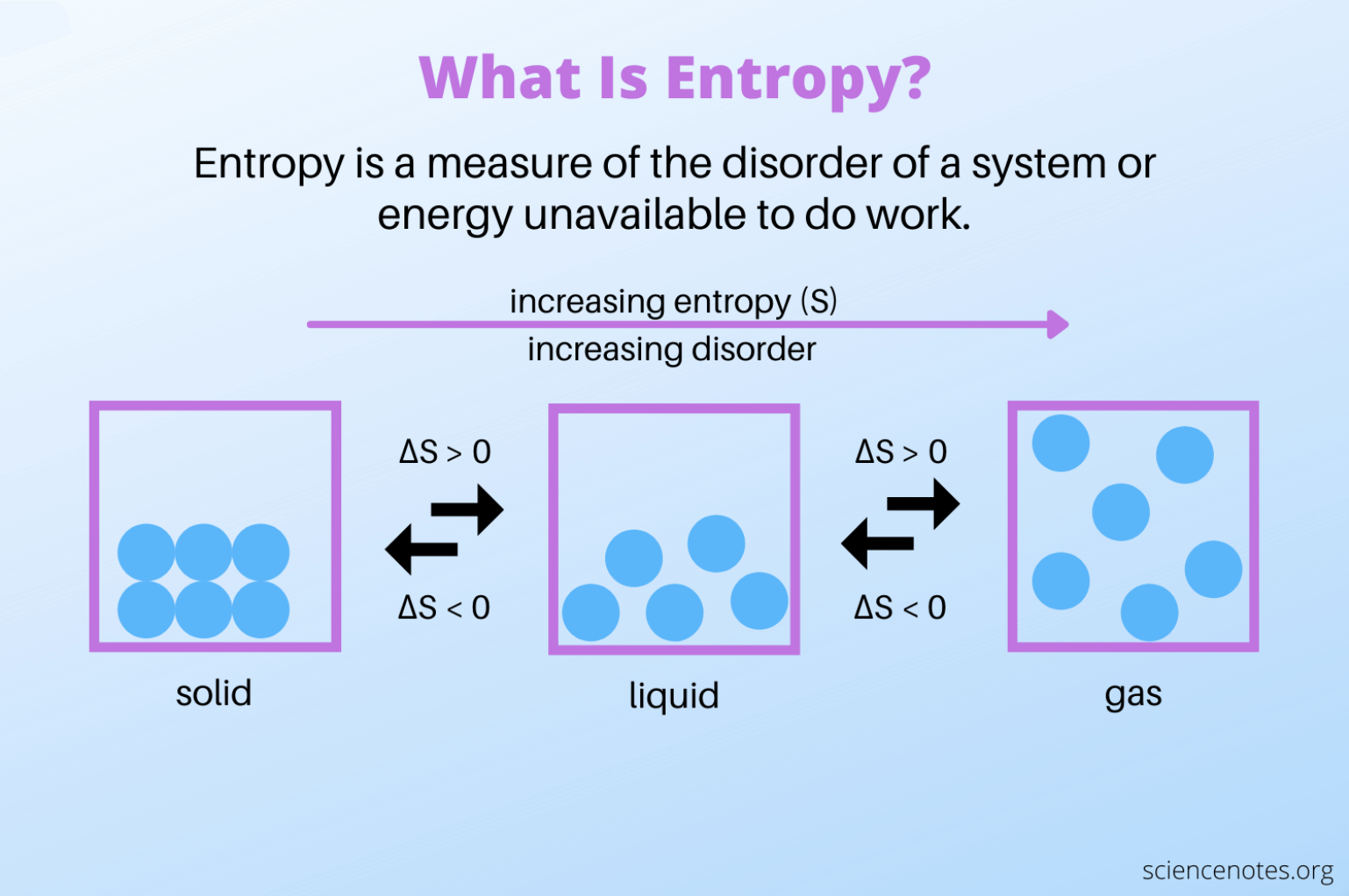
This is the expected direction of change for any unattended system. What has actually occurred on Earth runs in the opposite direction. A hostile, lifeless planet with no atmosphere capable of supporting life gradually gave rise to simple organisms, then to increasingly complex life forms, and ultimately to human beings of extraordinary biological sophistication. Instead of crumbling toward disorder, things developed continuously toward higher and more complex forms of existence. The law of Thermodynamics has effectively been reversed. Unattended systems do not do this. The scientific framework we rely upon tells us this could not have happened without the Earth being attended and guided throughout.
c. DNA Coding and the Laws of Probability
The laws of probability offer a precise way of quantifying what chance can and cannot produce.
If a single die is thrown, the probability of obtaining any specific number - say, a six - is one in six. If two dice are thrown simultaneously, the probability of obtaining double sixes is one in thirty-six. If the same pair of dice is thrown 36,000 times and produces double sixes every single time, the probability of that occurring by chance requires multiplying 1/6 by itself 36,000 times. The resulting number is so vanishingly small that it is, for all practical purposes, indistinguishable from zero. No rational observer would call such a sequence coincidental. They would conclude that some force was producing the result.
This is the context in which the DNA molecule must be considered.
Inside the nucleus of every human cell are chromosomes. Within those chromosomes is the DNA molecule - a structure so compact it is invisible to the naked eye, yet one that stores coded hereditary information of staggering complexity. DNA functions like a computer program: it stores, transfers, and executes encoded instructions that direct the formation and maintenance of entire living organisms. The information encoded in a single human DNA molecule has been estimated as sufficient to fill 500,000 pages of densely printed text. This entire code fits within a single cell. The total DNA required to code every person alive on Earth today would fit inside a space no larger than an aspirin tablet.
Two prominent scientists, Fred Hoyle and N. Chandra Wickramasinghe, calculated the probability of life forming by random, undirected chemical processes. Their estimate: less than one chance in ten to the power of 40,000. To appreciate the scale of that number, consider that winning a major lottery carries odds of roughly one in 45 million - a number with seven zeros. The odds against life arising by chance involve a number with 40,000 zeros.
Hoyle described the likelihood of the first living cell forming by chance as comparable to "a tornado sweeping through a junkyard and assembling a Boeing 747 from the materials therein." This is not rhetorical excess. It is a mathematically grounded comparison.
No matter how chemicals are combined, they do not spontaneously produce DNA. They produce no intelligent code of any kind. A computer program does not write itself. The intelligence encoded in software originates in the mind of the programmer who designed it. DNA is a program of complexity so far beyond anything human engineering has produced that the comparison is almost absurd. The same logic applies with equal force: the intelligence encoded in DNA must have originated outside DNA, in a mind that preceded and designed it.
Many researchers working on the origin of life have now arrived at the same conclusion that Hoyle reached: life could not have arisen by chance or by any known natural process. Various speculative scenarios continue to be proposed, but they all share a common flaw - they attempt to explain how life evolved without first explaining how life came to exist at all. Nothing can undergo evolution unless it has first been created.
d. The Complexity of the Human Brain
All living things are extraordinarily complex. Even the simplest single-celled organism operates through systems of coordination and precision that dwarf anything human technology has produced. But no living structure surpasses the complexity of the human brain.
Every cubic inch of the human brain contains at least 100 million nerve cells, interconnected by approximately ten thousand miles of fibers. The brain stores and processes information without a fixed capacity limit - unlike any artificial storage medium, it does not fill. The more it is exercised, the more capable it becomes. Neurologists and computer scientists alike acknowledge that no machine yet built approaches the brain's architecture, let alone its performance.
The brain capabilities of even the smallest insects are remarkable in their own right. The tiny brain of a bee navigates enormous distances with a precision that outstrips our most advanced avionics systems. Ants coordinate complex social structures, engineering projects, and sophisticated communication systems within a volume smaller than a grain of rice. These miniature biological computers put human-built technology to shame.
Dr. A.E. Wilder-Smith observed: "When one considers that the entire chemical information to construct a man, elephant, frog or an orchid was compressed into two minuscule reproductive cells, one can only be astounded. In addition to this, all the information is available on the genes to repair the body when it is injured. If one were to request an engineer to accomplish this feat of information miniaturization, one would be considered fit for the psychiatric clinic."
When a person examines a computer or a television set, how many would deny that the device reflects the existence of a designer? Yet many of those same people will deny that the infinitely more sophisticated human brain was itself designed by a more intelligent creator. The inconsistency requires an explanation that none of them have satisfactorily provided. If it would be foolish to suggest that a typewriter assembled itself by chance, it is incomparably more foolish to suggest that life - far more complex than any human-made machine - arose by unintelligent coincidence.
e. The Macro-Micro Pattern
The universe exhibits a structural pattern that repeats itself from its largest observable scales to its smallest.
At the cosmic level, moons orbit planets. Planets orbit stars. Stars orbit the centers of gravity of their galaxies. Our galaxy, the Milky Way, contains no fewer than 100 billion individual stars, all rotating around a common center. Galaxies group into clusters, and individual galaxies orbit the cluster's center of gravity. Clusters group into superclusters, which obey the same laws. The pattern - a central body with other bodies in continuous orbit around it, governed by gravity - recurs at every scale of cosmic organization we can observe.
At the subatomic level, the pattern is identical. The atom consists of a nucleus at the center with electrons in continuous motion around it. The same architectural arrangement that governs superclusters spanning hundreds of millions of light-years is reproduced in structures smaller than any microscope can directly resolve.
This consistency across scales of such vastly different magnitude is not the signature of randomness. It is the signature of a single Designer working with coherent intention - the same fingerprint appearing at every level of a creation that ranges from the incomprehensibly vast to the incomprehensibly small.
It was supposedly amusing when the first man in space, the Soviet cosmonaut Yuri Gagarin, declared from orbit: "Where is God? I do not see Him!" The irony is that he met his death in an aircraft accident - still in the air where he had searched and found nothing. One suspects he found his answer then.
The arguments above are a selection from a much larger body of scientific evidence spanning nearly every field of inquiry. Together they establish that a supreme, non-physical, intelligent power is responsible for the creation and sustaining of the universe. The evidence does not merely suggest this conclusion. It demands it.
Third Debate: If a Creator Exists, How Many Are There?
Granting that a supreme power created the universe, one further question demands examination: could there be more than one such power?
To answer this, the distinction between the absolute and the relative is essential.
Anything relative is defined in relation to something else. The oven in our earlier example was hotter than the cold room - but placed inside an active volcano, the same oven would seem very cool. An athlete is fast compared to a pedestrian but slow compared to a car. In every case, the description is relational: it depends on what is being compared. Relative things always exist within a web of comparison - there will always be something cooler, larger, older, faster, or more powerful than they are.
The absolute, by contrast, is self-existent and independent. It is not defined in relation to anything, because nothing exists outside or beyond it to serve as a point of comparison.
The power that created the universe must be absolute in precisely this sense. It preceded the universe. It is independent of the laws of physics, because it created those laws. Nothing within the universe can be compared to it, because everything within the universe is its effect. A cause is prior to its effects in every sense - it cannot be measured against them.
Now consider what the existence of more than one god would require. Two gods would immediately raise the questions: which came first? Which is more powerful? Which has greater knowledge? The moment comparison between them becomes possible, neither is absolute - each is defined in relation to the other, which makes each relative. But a relative power is not the supreme, non-physical, uncaused Creator that the arguments above establish. The power responsible for bringing the universe into existence from nothing cannot be relative, because it precedes and exceeds everything that is relative.
If God is genuinely absolute - prior to the universe, independent of all its laws, beyond comparison with anything within creation - then by definition there can be only one. Plurality requires comparison. Comparison requires relativity. And relativity is incompatible with the nature of the Creator who stands before and beyond the universe He brought into being.
The universe had a beginning. That beginning required a cause beyond the laws of physics. The complexity, order, and coded intelligence evident throughout creation at every scale cannot be attributed to chance. And the Creator responsible for all of it is, by the logic of His own nature, singular and absolute - one God, without equal and without companion.