
How do we know Zakat is 2.5%?
A recurring objection from some who claim to follow the Quran alone is that anything not specified verbatim in the Quran cannot be considered binding. If the Quran does not state "2.5%" explicitly, they argue, then no specific percentage can be obligatory. This position sounds principled but it reflects a misunderstanding of how God communicates through the Quran - and God Himself provides the corrective in the very second chapter, the longest chapter, the one He chose to name The Heifer.
The Lesson of the Heifer
When God commanded the Children of Israel through Moses to sacrifice a heifer, the command was straightforward:
[2:67-71] Moses said to his people, "GOD commands you to sacrifice a heifer." They said, "Are you mocking us?" He said, "GOD forbid, that I should behave like the ignorant ones."...
Rather than simply obeying, they questioned. What heifer? What age? What color? What condition? Each question drew a more specific answer from God - not because God had forgotten to provide the information, but because the questioning itself was the problem. God is All-Knowing. He does not overlook what His servants need in order to carry out His commands. When He issues a straightforward commandment, the response He expects is obedience, not interrogation.
[2:71] ...They finally sacrificed her, after this lengthy reluctance.
That God placed this story at the opening of the longest chapter in the Quran - and named the entire chapter after it - is not incidental. It is a permanent lesson embedded in the structure of the revelation itself: when God commands, our duty is to carry it out without the kind of excessive scrutiny that masks reluctance as rigor. To ask "but exactly how much is the Zakat?" in a tone of doubt rather than a spirit of genuine inquiry is to repeat the error of the Children of Israel.
Is God not All-Knowing? Did He fail to foresee that His servants would need to know the amount? Did He forget to include it?
[6:115] The word of your Lord is complete, in truth and justice. Nothing shall abrogate His words.
The Method: Start With Practice, Remove the Impurities
Both the Salat and Zakat were established with Abraham and have been practiced continuously by every prophet and community of believers since (14:40, 21:73, 19:54-55, 10:87, 2:83, 5:12, 19:31). God commanded Muhammad to follow the religion of Abraham (16:123), not to establish new practices from scratch. This means that for practices originating with Abraham, the correct approach is not to demand that the Quran reproduce every detail from first principles - it is to begin with what has been transmitted and then use the Quran to remove whatever corruptions have accumulated over time.
God describes this exact process:
[13:17] He sends down water from the sky, causing the valleys to overflow, then the rapids produce abundant foam. Similarly, when they use fire to refine metals for their jewelry or equipment, foam is produced. God thus cites analogies for the truth and falsehood. As for the foam, it goes to waste, while that which benefits the people stays close to the ground.
When metal is refined, the impurities rise as foam and are discarded. What remains is the pure material. This is the methodology for recovering a corrupted practice: identify what has been added that has no Quranic basis, remove it, and what remains is the original truth.
The ablution offers a clean example of this method in action. God specifies exactly how it is to be performed in 5:6 - four steps, nothing more. Yet most Muslims today perform ablution with many additional requirements that have no Quranic basis. These are the foam. The four steps are the metal.
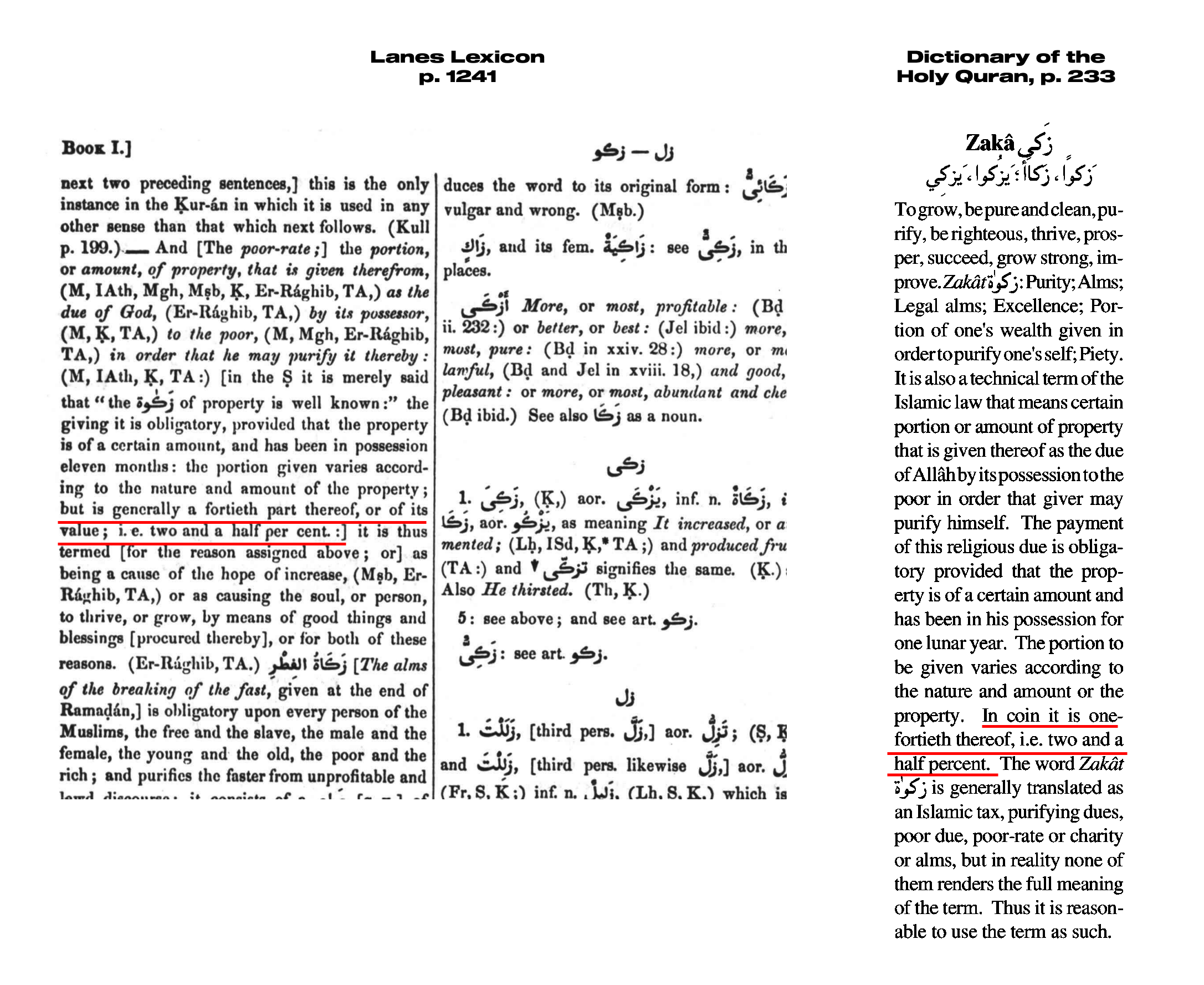
Applied to Zakat, the same process yields a clear result. The Quran tells us Zakat must be paid on the day income is received (6:141), that it applies to everything earned (2:267), and that it is to be given from what is genuinely excess (2:219). The corruption that has entered the practice is paying it once a year and calculating it on total accumulated wealth. Strip those innovations away and the original practice - 2.5% paid on income at the time it is received - is what remains. This rate has never been in dispute across the history of Submission. It was transmitted from Abraham, generation after generation, in the same way the Salat itself was transmitted.
The Quranic Confirmation: The Known Amount
The Quran does not leave this entirely to transmitted practice. It confirms the existence of a specific, defined amount through precise language that rewards careful reading:
[70:24] Part of their money is set aside (haqqun ma'lum).
The Arabic of this verse reads: haqqun ma'lum - literally, the known right, or the known amount. Ma'lum is used specifically for a known count. See 77:22, 38:81, 56:50, 15:21, and many more.
God does not say an amount, or some portion, or whatever they choose. He says the known amount - a specific, established figure that the believers are expected to know and give. The definite character of the phrase is itself the confirmation: there is a known amount, it has always been known to the Submitters, and that amount is 2.5%.
This figure has been passed down from the time of Abraham to our time, just as the Salat has been passed down - not as an innovation of later scholarship, but as the original practice of the religion God established through His first messenger of Submission. The Quran does not need to write "2.5%" in numerals any more than it needs to specify each movement of the Salat. The practice was already established. The Quran confirms its existence, defines its principles, corrects its corruptions, and in 70:24 acknowledges that there is a known, fixed amount - which is all the Quranic confirmation the question requires.