
Alban Fejza's Claim to Messengership: A Quranic Refutation
I. The Name Manipulation Problem
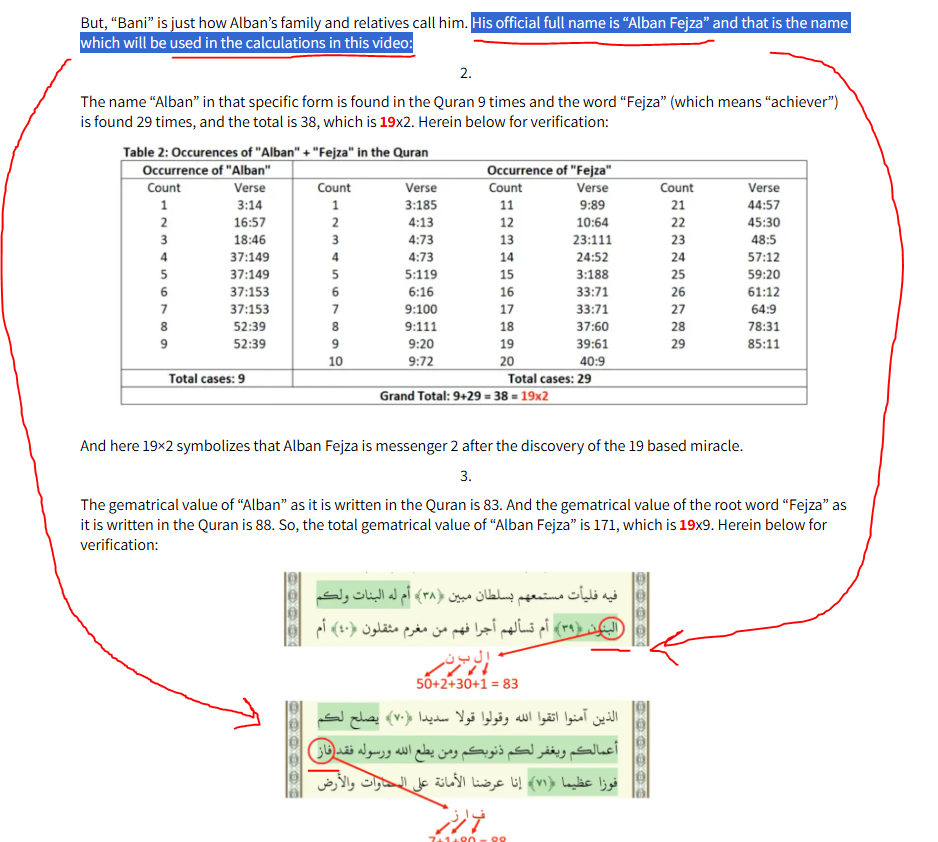
Alban Fejza opens his mathematical proofs material with a bold declaration: he will use his full official name, "Alban Fejza," as the basis for his calculations. He then almost immediately contradicts his own stated methodology - and attempts to obscure the contradiction.
The Arabic rendering he uses for "Alban" is البن. This is incorrect. The proper Arabic transliteration is ألبان - and the difference is not trivial. His version drops the Hamza entirely and eliminates an alif, producing a word that is not his name. Two separate errors in a single word, in a calculation whose entire premise depends on the precision of that word.
His last name fares no better. "Fejza" can be transliterated into Arabic in several defensible ways: فيزا, or فيزة if the prominent Z sound is to be preserved, or فيجا if the strong J sound takes precedence - giving فيجزة as the most complete rendering. What Fejza claims it to be is فاز. This is not a transliteration of his name. It is a different word entirely.
The deeper issue is that neither Alban nor Fejza are names of Arabic origin. Foreign names present a fundamental problem for this kind of calculation precisely because they have no single correct Arabic spelling - the same name can be legitimately written multiple ways depending on which phonetic elements are being prioritized, producing different letter values and entirely different numerical results. "Xavier," for instance, can be rendered as زافير (Zafir) or كازافييه (Kazafiyah) - two Arabic forms that sound nearly different from one another yet both translate back to the same English name.
This is not a minor technical difficulty. It is a foundational one. The calculation is built on a name that has no fixed Arabic form, transliterated incorrectly, and then manipulated further to produce a desired result. This stands in direct contrast to Rashad Khalifa, whose first and last names are both of Arabic origin, carry unambiguous spellings, and require no manipulation whatsoever.
God supports His chosen messengers with signs that authenticate divine authority - Abraham with the fire, Saleh with the camel, Jesus with his miracles, Rashad with the mathematical code of the Quran. These signs do not merely suggest divine favor; they constitute proof of it. A calculation built on a manipulated, non-Arabic name with no fixed spelling is not a sign. It is a constructed result.
II. The Proof Needed - What Alban Lacks
Alban goes so far as to claim that no new proofs or miracles can be brought forth. His position is that new miracles can only emerge if old ones are first abrogated, citing 2:106 as support. This reading is both contextually distorted and internally illogical. The scientific miracles embedded in the Quran coexist simultaneously - no passage of the Quran vanishes when a new scientific miracle is discovered within it. That is not how the Book operates.
Two points dismantle his claim directly.
First, 2:106 is a conditional statement about abrogation - it addresses the replacement of one ruling with another under specific circumstances. It does not establish a universal law that every miracle must be retired before a new one can appear. Alban has taken a conditional Quranic mechanism and expanded it into a blanket restriction that the verse itself does not authorize.
Second, the claim is refuted just a handful of verses later within the same chapter:
[2:118] Those who possess no knowledge say, "If only God could speak to us, or some miracle could come to us!" Others before them have uttered similar utterances; their minds are similar. We do manifest the miracles for those who have attained certainty.
The language is plural and present-tense. Multiple miracles can be - and are - manifested simultaneously for those who have reached certainty. Alban lacks even a single one.
His citation of 17:59 compounds the problem. He isolates the phrase "we stopped sending miracles" and presents it as a standalone divine declaration that the age of miracles has closed. This is a corruption of the verse. Read in full, with its own title intact - Old Kind of Miracles Made Obsolete - the verse is explaining something far more specific:
[17:59] What stopped us from sending the miracles is that the previous generations have rejected them. For example, we showed Thamoud the camel, a profound miracle, but they transgressed against it. We sent the miracles only to instill reverence.
This verse is addressing a particular category of miracle - the kind sent to previous nations as a final ultimatum, whose rejection sealed those nations' fate. It is not a declaration that miracles ceased after the camel of Thamoud. Miracles continued to appear throughout the Quran long after that event. Extracting a single clause from this verse and presenting it as evidence that divine authentication is no longer possible is precisely the kind of scriptural manipulation the Quran warns against:
[3:78] There are those who distort the scripture with their own tongues to make you think it is from the scripture, when it is not from the scripture, and they claim it is from God, when it is not from God.
God has always sent His messengers supported by clear proofs:
[57:25] We sent our messengers supported by clear proofs...
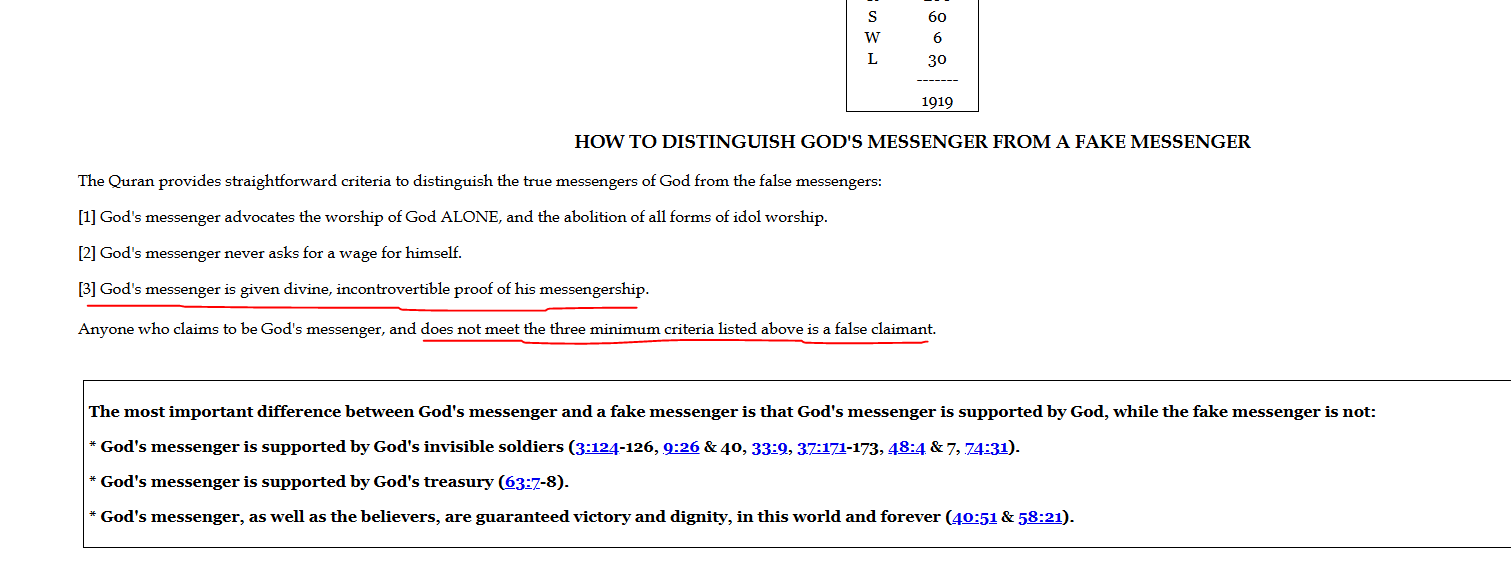
This is the standard. Messengers are authenticated - not by self-generated checklists of invented criteria, but by signs that demonstrate divine authority independently of the claimant's own testimony. Alban's attempt to argue that such authentication is no longer available is not a theological position derived from the Quran. It is a defense mechanism for the absence of any proof to present.
Even Rashad himself confirms this standard towards the end of Appendix 2:
III. Clarification 23 - The Mahdi, the Antichrist, and Unsupported Claims
In Clarification 23, Alban places significant emphasis on the appearance of the Mahdi and the Antichrist before the end of times, drawing on Rashad Khalifa's writings about the End of the World. This creates an immediate and serious problem.
Rashad makes clear in his writings that he himself is the awaited Mahdi. Alban then associates the title of Mahdi with a separate individual named "Ahmed." These two positions are incompatible, and Alban offers no Quranic basis for the reassignment.
The Antichrist question is equally problematic. Rashad is explicit: the Antichrist is not a Quranic figure. The term appears nowhere in the Quran, and Rashad therefore does not treat it as a legitimate Islamic concept. Alban, rather than engaging with this position on Quranic grounds, attempts to construct a case for the Antichrist's existence through bold assertions - none of which are supported by Quranic citation.
His citation of 9:30 as a reference to this supposed Antichrist figure is particularly telling: the verse has nothing to do with any such being. It describes what we already know about the reverence some Christians held for Jesus as the son of God, and recalls the historical regard for Ezra among certain Jewish communities. There is no Antichrist in that verse, by any reasonable reading.
This habit - making theological claims without Quranic support, taking verses out of context, and forcing them to fit a predetermined conclusion - is a recurring feature of Alban's material and one that will be demonstrated further below.
IV. The "Logical Proof" Video - A Point-by-Point Analysis
Alban's video presenting what he calls a "logical proof" of his messengership contains a series of claims that collapse under Quranic scrutiny.
44:13 and the Clarifying Messenger (1:30): Alban demands that 44:13 calls for a Clarifying Messenger, implying that Rashad did not see himself as the messenger in 44:13. The very title of 44:13 in Rashad's translation reads "God's Messenger of the Covenant" - meaning Rashad saw himself as the messenger in that verse. There is no vacancy being pointed to.
A mandatory "Clarifying Messenger" (1:50): Alban claims there must be another messenger deemed the "Clarifying Messenger." There is no such requirement anywhere in the Quran. This is his own claim, not a Quranic one - unlike the specific prophetic covenant in 3:81 regarding Rashad.
Financial independence (3:02): Alban argues the messenger must be financially independent and presents his own financial independence as evidence. This inverts the Quranic principle entirely. Messengers ask for no wage - that is established. But financial independence is not the criterion; it is the absence of financial demand on others that the Quran describes. Declaring oneself financially independent as a qualification for messengership is not what the Quran teaches.
Circumcision (3:24): Alban claims the messenger must be circumcised. No such requirement appears anywhere in the Quran. This criterion has no scriptural basis and was apparently included because Alban can claim to meet it - which illustrates the pattern: criteria are being generated to fit the claimant, not derived from the Book.
Courage (4:20): The messenger, Alban argues, must be courageous. Moses expressed fear repeatedly throughout the Quran. Muhammad demonstrated timidity on multiple occasions. Rashad himself experienced fear in the earlier period of his messengership. Courage is not a prerequisite for divine appointment - it is something that can develop over the course of a messenger's mission. Requiring it as an entry condition contradicts the documented experience of confirmed messengers.
Certainty of salvation (4:30): Alban claims to be certain he is among those who will reach the highest levels of Paradise. This position contradicts the Quran more broadly than almost any other claim in the video. Abraham - described in the Quran as a beloved friend of God - expressed no such certainty:
[26:82] And I hope that my Lord will forgive my sins on the Day of Judgment.
The Quran is explicit that knowledge of who will be saved belongs to God alone (6:50, 11:31, 27:65, 7:188). Even Muhammad was told:
[7:188] Say, "I have no power to benefit or harm even myself."
The warnings to prophets in 39:65 and 69:44-47 are among the most severe in the entire Quran. A man who is certain of his place in the highest Paradise has not read these verses carefully.
Intellectual ability (4:50): The messenger must be intellectually capable - and Alban is smart. Intelligence is not listed as a requirement for messengership anywhere in the Quran. The only quality the Quran consistently associates with those who can receive its message is sincerity (56:79). The self-assessment embedded here is also worth noting: a messenger who argues for his own messengership on the basis of his own self-reported intelligence has introduced a criterion that is both unverifiable and self-serving.
Marriage and children (5:10): The messenger must be married with children - except, Alban notes, for the last messenger, who need not be. The construction of this criterion is revealing: it creates a category into which Alban can place himself regardless of his family situation. If he has children, he meets the general requirement. If he does not, he is the last messenger and is exempt. This is not a criterion derived from the Quran. There is no mention of such requirements anywhere in the text.
The mother's belief (5:30): The messenger's mother must be a believer. Applied consistently, this criterion would require the rejection of Jesus - Mary was not married when she gave birth, and the Jewish contemporaries of Jesus used precisely this kind of reasoning to dismiss his claim. It would also raise serious questions about Muhammad, whose parents were operating within a polytheistic society, and about Adam, who had no human mother at all. The criterion is self-contradictory and has no Quranic basis.
Trusting the mother of the Messenger (5:55): This is not a requirement anywhere in scripture. Since when does the mother have to believe her son is the Messenger? This reasoning devolves back into the logic of Sunnah and Hadith - verification through human testimony rather than divine sign. There is no basis for this in the Quran.
Believing friends (6:58): The messenger must have no disbelieving friends. Alban cites five verses in support of this claim. None of them establish any such requirement. The Quran commands believers not to take disbelievers as intimate allies in place of believers - this is a general instruction to the community, not a criterion for identifying a messenger.
The pattern throughout this video is consistent: criteria are invented, cited verses do not support the claims made, and the list of qualifications is constructed in a way that Alban happens to meet while excluding others. This is not a Quranic proof of messengership. It is a self-fulfilling checklist.
V. Clarification 43 - The Distortion of the Qiblah
In Clarification 43, Alban effectively eliminates the Qiblah. He argues that since all directions belong to God, the specific direction of prayer is a matter of personal preference rather than religious obligation - "not even religion," in his words, "it's geography."
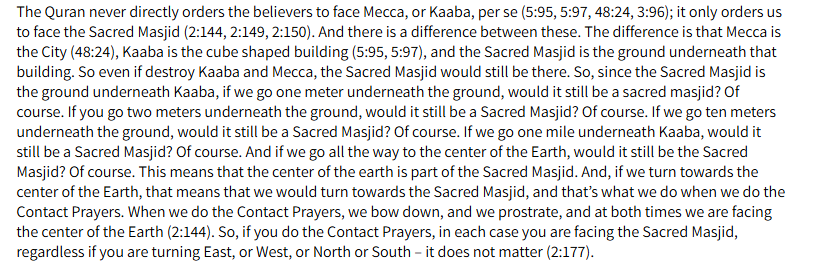
The Quran does not support this position. It directly contradicts it:
[2:149] Wherever you go, you shall turn your face (during Salat) towards the Sacred Masjid. This is the truth from your Lord.
This is not a suggestion. It is described as "the truth from your Lord" - language the Quran reserves for binding declarations. Verses 2:142, 2:145, and 2:150 all make clear that there is a specific correct direction that is not interchangeable with all other directions.
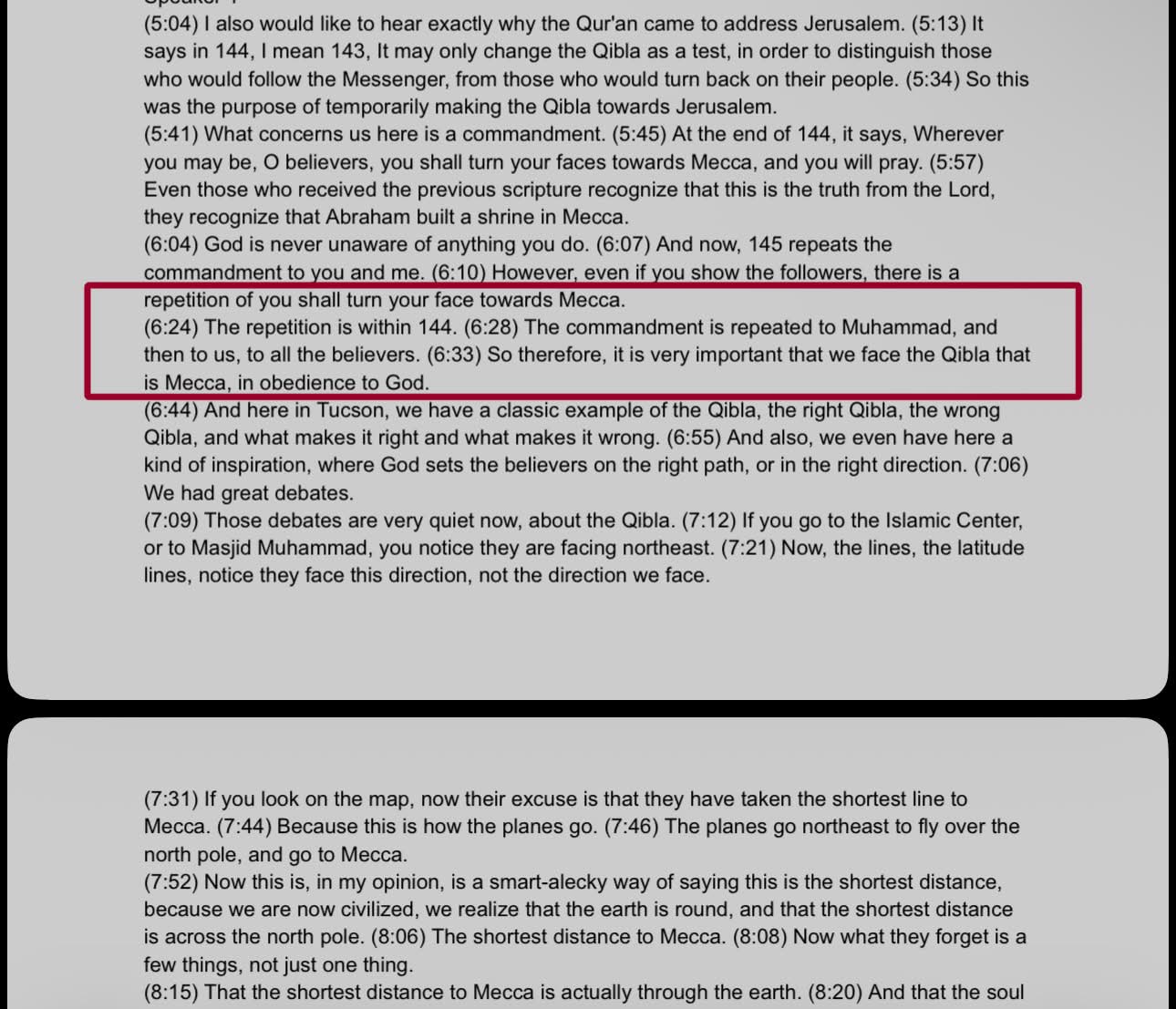
Alban's reading of 2:144 - where he claims the Qiblah is simply "whichever direction the messenger prefers" - introduces another problem. If the Qiblah is whatever the messenger personally prefers, then the religion is determined by human preference rather than divine command. Muhammad prayed facing Jerusalem before the Qiblah was changed to Mecca. That change was commanded by God - it was not an expression of Muhammad's preference. And the rites of worship, including the direction of prayer, were established through Abraham, not through any messenger's personal inclination (2:128-129).
Alban's own conclusion from this reading is that for believers in the United States and Canada, the acceptable Qiblah is "the whole range of directions from North-East to South-East." This is not a Qiblah. It is the elimination of one.
Rashad Khalifa's position on this matter is clear and consistent with the Quranic text: the commandment to face the Sacred Masjid in prayer is binding, applies to all believers, and is not a matter of preference. False messengers are unable to preserve the rites of God - and the distortion of the Qiblah is a direct demonstration of this principle.
VI. The Underlying Issue
What runs through all of the above is a single consistent pattern: claims made without Quranic basis, verses cited without connection to the points they are supposed to support, criteria invented to fit the claimant, and established Quranic teachings contradicted without acknowledgment.
Producing a list of Quranic verses related to supplication, or citing verses about striving in God's cause, does not constitute a divine message. These verses are accessible to any sincere reader of the Quran. What would constitute a message is what the Quran itself describes as the authenticating function of messengership: a sign that demonstrates divine authority - not a calculation built on a foreign name with no fixed Arabic spelling and adjusted until it produces the desired result.
The Quran is direct on what it means to fabricate divine appointment:
[6:93] Who is more evil than one who fabricates lies and attributes them to God, or says, "I have received divine inspiration," when no such inspiration was given to him?
This is not a question requiring deliberation. The criteria for evaluating a claim to messengership are not invented by the claimant. They are established by the Book. And when the Book is the standard, the case examined here does not hold.