
Clarification 6 - Limits of Organized Religion
Part of Alban Fejza: Refutations - The "Clarifications"
I. His Conclusions, and How He Reaches Them
Clarification 6 announces that organized religion was established correctly only four times in history - under Moses, David, the Apostles, and Muhammad in Medina - and that "now the time has come for the fifth case, and this time it will last until the End of the World." The correct structure, he says, is "a peaceful religious army" with a top-down hierarchy; the only authorized meeting is the Friday Congregational Prayer - every other religious gathering is a "distraction" - and membership reduces to two audited rituals: attend Jumu'ah visibly, give Zakat collectively, "if you do not do these two, you get kicked out, regardless of how good you are."
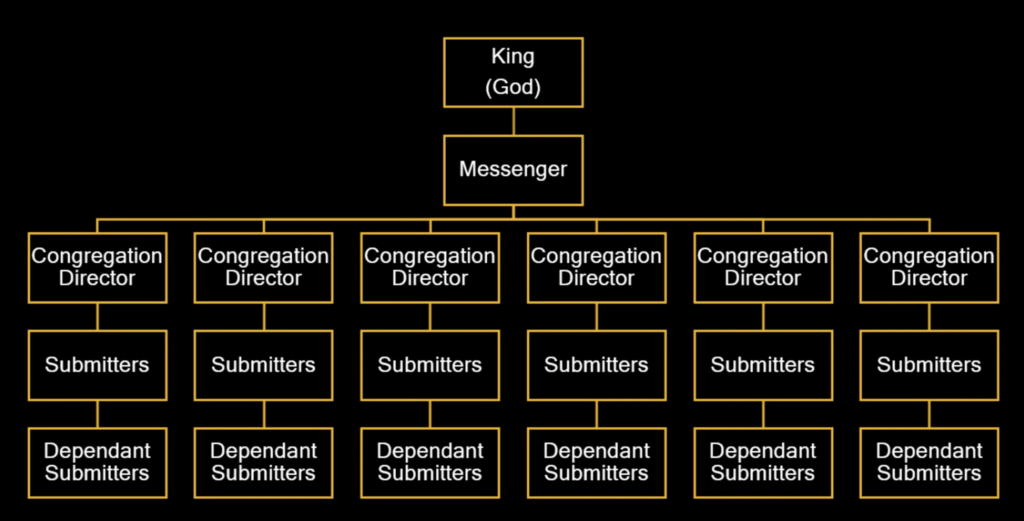
Note what sits at the operating top of this live chart. The "Messenger" is defined as "the Quran, or a human being authorized by God to promote the Quran" - and since this is presented as today's active command structure, with Congregation Directors appointed "through a God-given system" beneath it, the human occupant of that box is Alban himself: directly under God, above every director, every submitter, and a bottom caste of "Dependent Submitters." Each pillar of this construction is examined below - beginning with the three verses he quotes as God's command to organize, because none of them says it.
II. The Commandment "Organize" Does Not Exist - His Prooftexts Are Rewritten
Clarification 6 closes by quoting 9:38, 9:39, and 9:41 as direct commands to "organize." Here is 9:38 as he prints it: "O you who believed, when you are told, 'Organize in the cause of GOD,' why do you become heavily attached to the material things?" And here is the verse in Rashad's translation:
[9:38] O you who believe, when you are told, "Mobilize in the cause of GOD," why do you become heavily attached to the ground? Have you chosen this worldly life in place of the Hereafter?...
Two words have been replaced inside a quotation: "Mobilize" has become "Organize," and "the ground" has become "the material things." The same substitution is repeated in his 9:39 - Rashad: "Unless you mobilize, He will commit you to painful retribution and substitute other people in your place..." - and then 9:41 receives the fullest treatment. He prints: "You shall readily organize, light or heavy, and strive with your money (collective charity) and your lives (collective prayer) in the cause of GOD." Rashad's verse:
[9:41] You shall readily mobilize, light or heavy, and strive with your money and your lives in the cause of GOD. This is better for you, if you only knew.
"Mobilize" is rewritten, and two parentheticals are inserted into God's words - "your money" is annotated into his collective-Zakat system, and "your lives" into congregational prayer. This is the same maneuver as the "(from that same wealth)" insertion in Clarification 5, performed this time on the verses he calls his mandate. The passage he is rewriting is the mobilization call for a military campaign - the same word Rashad renders "mobilize" throughout (4:71: "you shall remain alert, and mobilize as individuals, or mobilize all together"), and the same passage whose continuation, 9:122, he never mentions: "When the believers mobilize, not all of them shall do so. A few from each group shall mobilize by devoting their time to studying the religion..." The one organizational instruction actually inside his prooftext passage decrees religious study groups - the very gatherings his meetings doctrine bans. A commandment "Organize in the cause of God" appears nowhere in the Quran. It was manufactured by find-and-replace.
III. The Wall That Is Not a Pyramid
He says his hierarchy "looks like bricks in one wall, and that is exactly what God calls it in the Quran." The verse:
[61:4] GOD loves those who fight in His cause united in one column, like the bricks in one wall.
Read what it describes: those who fight in His cause - stripped again - standing united in one column, bricks in one wall. A wall is a formation of equals, side by side, each brick bearing alike. It has no top and no bottom, no box above the bricks. His diagram is the opposite object: a five-layer pyramid with himself one step under God. The metaphor he borrowed refutes the structure he drew.
The hierarchy audit fares no better. He claims to have gathered "all the hierarchical positions mentioned in the Quran," but two of his eleven are not in the Quran at all: "Emir" never occurs as a title - 4:59 speaks of "those in charge among you," a description, not an office - and "Mulla" is a Persian-era clerical title with no Quranic occurrence whatsoever, which he then "removes" as if it had been there. "Scholar (Alim) - replaced by scientists" inverts 35:28, where the knowledgeable are defined as "the people who truly reverence GOD" - reverence is not a position that lapsed to laboratories. And the floor of his pyramid commits a genuine theological inversion: he assigns "Abd" - servant - to a dependent under-caste (minors, the ill, those without internet or English) who "communicate with the religious organization through another submitter, but not directly." In the Quran, 'abd is the honorific of the messengers themselves - "When GOD's servant advocated Him alone..." (72:19) - and the condition of all creation: "Every single one in the heavens and the earth is a servant of the Most Gracious" (19:93). Every box of his chart, from the top he occupies to the bottom he assigns others, is his own invention wearing Quranic vocabulary.
IV. The Meetings Doctrine Bans What the Quran Blesses
The claim that the Friday Prayer is "the only authorized meeting" and everything else - studies, conferences, gatherings - is a "distraction" collides with the verse he himself paraphrases to support it:
[4:114] There is nothing good about their private conferences, except for those who advocate charity, or righteous works, or making peace among the people. Anyone who does this, in response to GOD's teachings, we will grant him a great recompense.
The exception is the ruling: conferences advocating charity, righteous works, or peace are good, and God attaches a great recompense to them. A Quranic study is a conference advocating righteous works. So is a gathering of believers making peace. His own prooftext blesses what his doctrine bans - and 9:122, quoted above, decrees devoted religious study outright. His Saturday warning fabricates a prophecy from 16:124: "The Sabbath was decreed only for those who ended up disputing it..." - a statement about the Sabbath decreed for past communities, converted into "God's prediction" that modern believers who meet on Saturdays "will always end up disputing." And his Day-of-Judgment questionnaire - where "Did you attend the Friday Prayer?" appears on the list but nothing else does - exists in no verse; it is invented eschatology deployed as leverage.
Rashad's translation then seals the point with a header. The title Rashad placed over 18:28 reads "Quranic Study Groups" - and the verse beneath it is a command:
[18:28] You shall force yourself to be with those who worship their Lord day and night, seeking Him alone. Do not turn your eyes away from them, seeking the vanities of this world. Nor shall you obey one whose heart we rendered oblivious to our message; one who pursues his own desires, and whose priorities are confused.
God's Messenger of the Covenant titled this verse as the decree of the very gatherings Clarification 6 dismisses as "distractions" - and the verse commands the believer to force himself into that company and never turn his eyes from it. Then it continues into a warning that lands squarely on the man teaching otherwise: do not obey the one who would pull you away from the worshipers, "one who pursues his own desires, and whose priorities are confused." Alban's meetings doctrine does not merely lack support in Rashad's translation. It instructs believers to do what 18:28 forbids, and to abandon what 18:28 and its title command.
What remains true is 62:9: when the Friday Congregational Prayer is announced, "you shall hasten to the commemoration of GOD, and drop all business." The Friday Prayer is obligatory - no one in Submission disputes it. What the verse does not contain is exclusivity, and notice where the doctrine lands: the one authorized meeting of the properly organized religion turns out to be the Friday sermon Alban streams on his own website. In Clarification 5 he warned that "religion can not be contained, codified and defined by social media groups and internet webpages." The completed system is a religion whose single meeting is his webpage.
V. "Rashad Did Not Organize" Is False - and the Comparison Runs Backwards
To explain why he organizes what God's Messenger of the Covenant did not, Alban offers: "This is why I am organizing it and Rashad Khalifa did not. The difference between Rashad and me is like the difference between Abraham and Moses." The premise is false. Rashad founded and led Masjid Tucson - he was martyred inside it - held its Friday prayers, ran its Quranic studies, convened the annual conferences of the International Community of Submitters, and published the community's monthly bulletin, the Submitters Perspective, from 1985 until his martyrdom in 1990 - the archive is on this site. Rashad organized the community of Submitters by every ordinary meaning of the word. What Rashad never did is the part Alban has added: payment registers, membership audits, expulsions, and a hierarchy with a messenger box at the top. Alban has not resumed something Rashad left undone; he has renamed Rashad's actual community activity - the studies and conferences - "distractions," and installed in its place the machinery Rashad never authorized.
The Abraham-and-Moses framing should also be read for what it does: it ranks Alban's function above Rashad's - Abraham merely brought what Moses organized. The Quran recognizes no such dispensation dividing "religion" from "organized religion": "He decreed for you the same religion decreed for Noah, and what we inspired to you, and what we decreed for Abraham, Moses, and Jesus: 'You shall uphold this one religion, and do not divide it'" (42:13). One decree, one religion - not an unorganized rite awaiting a fifth administrator. His four-establishments history is likewise built from materials the Quran does not contain: the Quran's seventy men of Moses were selected for an audience with God and struck by the quake (7:155), not seated as "70 Judges"; the Apostles are supporters of Jesus, not founders of a structure; and the Battle of Karbala appears nowhere in the Book. The sequence exists for its arithmetic: four correct establishments, and now the fifth - his - "until the End of the World." The reader of Clarification 12 has seen this shape before: whatever the series, Alban is its final term.
VI. Membership by Audit, Again
The "main verse of this video" receives the same treatment as his prooftexts. He prints 9:11 with numbered insertions and a new word: "give the Zakat (Collective Obligatory Charity)." Rashad's verse - "If they repent and observe the Contact Prayers (Salat) and give the obligatory charity (Zakat), then they are your brethren in religion. We thus explain the revelations for people who know" - contains no "collective." The word is inserted precisely where the doctrine needs it, because the doctrine is the audit: prove your prayer by weekly attendance, prove your charity so "other submitters can see," or "you get kicked out, regardless of how good you are." The Quranic answers were given in the refutation of Clarification 5 and stand here unchanged: 9:11 describes brethren, it does not commission a registry; anonymous charity is better and remits more of your sins (2:271); and "do not say to one who offers you peace, 'You are not a believer'" (4:94). He even supplies the contradiction himself: "No people should have the right to decide who gets in and who gets expelled" - announced for a system in which his appointed directors administer exactly those decisions.
Two further reversals close the case. His argument against giving charity directly to one's own family - that money must cross social classes, citing 59:7, a verse about the distribution of spoils - runs into the Quran's own priority list for charity: "The charity you give shall go to the parents, the relatives, the orphans, the poor, and the traveling alien" (2:215). Parents and relatives are named first, in the verse that answers the question "what to give." And his tidy split - Salat and Zakat are Organized Religion, fasting and Hajj are "personal" - contradicts his own Clarification 5, where fasting was declared the Zakat of the body, priced at 2.5% of annual pleasures. In one clarification fasting is a Zakat subcomponent; in the next, Zakat is collective and fasting is private. Systems invented verse by verse do not stay consistent between videos.
VII. What Survives - and What the Rest Is For
Peer review, as always: the Friday Prayer is obligatory, and 62:9's command to hasten and drop all business stands. Salat and Zakat are indeed the paired public rites of Submission. Muhammad is the last prophet. The religion's name is Submission (3:19). Even his point about the label "believers" has a real anchor - 49:14 does instruct those whose belief had not yet entered their hearts to say "We are Muslims (Submitters)" - though the verse corrects a specific claim of attainment; it does not legislate an organizational naming policy. And the desire for unity among submitters is right and Quranic.
Everything distinctive to Clarification 6 - the command to "organize" (rewritten from "mobilize"), the army pyramid (borrowed from a wall of equals who fight), the positions audit (padded with titles the Quran never mentions), the one-meeting doctrine (refuted by its own prooftext), the fifth-and-final establishment (built on extra-Quranic history), and the two-ritual membership gate (running on an inserted word) - assembles into a single machine: a religion whose only meeting he streams, whose officers he appoints, whose treasury his system audits, and whose messenger box he occupies, one step beneath God, until the End of the World. The Quran organized the believers around God alone. This organizes them around the administrator.
See also the pattern across his material: The Underlying Issue.