Clarification 12 - The "No More Miracles" Argument
Part of Alban Fejza: Refutations - The "Clarifications"
I. His Conclusion, and How He Reaches It
In Clarification 12, Alban presents what he calls "a quick logical conclusion why the Mathematical Miracle of the Quran is the last miracle until the End of the World." The argument is a flowchart: the Mathematical Miracle is inseparable from the Quran (his gloss of 38:1), the Quran is unchangeable (his gloss of 15:9), therefore the miracle is unchangeable and perpetual; new miracles come "only if old miracles end" (his rendering of 2:106); therefore the Mathematical Miracle must be the last miracle - "So, NO MORE MIRACLES (17:59)."
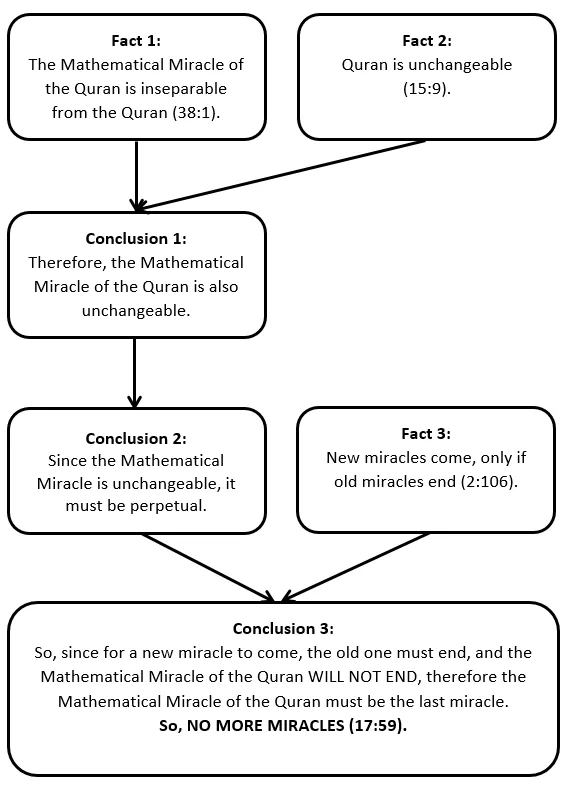
He then adds a numerical seal: the sura and verse numbers of his three "facts" (38:1, 15:9, 2:106) total 171, a multiple of 19, which he declares "is also the gematrical value of the name of Alban Fejza who discovered that the Mathematical Miracle of the Quran is the last miracle." The conclusion verse (17:59) totals 76, another multiple of 19. The whole diagram totals 247, a third multiple of 19.
Understand what this doctrine is for. If no miracle can ever come again, then no claimant after Rashad ever needs to produce one - and the one man in the conversation who has none is suddenly exempt. Every piece of this construction fails on its own terms, and the failures are examined below.
II. The Premise That Carries the Argument Is a Rewritten Verse
The entire flowchart hangs on one hinge - his "Fact 3": "New miracles come, only if old miracles end (2:106)." Here is the verse in Rashad's translation:
[2:106] When we abrogate any miracle, or cause it to be forgotten, we produce a better miracle, or at least an equal one. Do you not recognize the fact that GOD is Omnipotent?
The verse runs in one direction: when God abrogates a miracle, He produces a better or equal one. Alban reverses it - a new miracle comes "only if" an old one ends. The word "only" appears nowhere in the verse. A conditional statement is not its own converse: "when it rains, the ground gets wet" does not mean "the ground gets wet only if it rains." 2:106 is a conditional statement about abrogation - it addresses the replacement of one ruling with another under specific circumstances. It does not establish a universal law that every miracle must be retired before a new one can appear. Alban has taken a conditional Quranic mechanism and expanded it into a blanket restriction that the verse itself does not authorize.
And notice how the verse ends: "Do you not recognize the fact that GOD is Omnipotent?" The verse is a declaration of God's unrestricted power to produce miracles. Alban converts a verse about what God can do into a rule about what God cannot do.
III. The "Direct" Quote That Is Not in the Verse
Alban writes: "The Quran actually says the conclusion directly. It says, '…we stopped sending miracles…'. (17:59)"
Rashad's 17:59 contains no such sentence. Here is the verse in full, under its own title - Old Kind of Miracles Made Obsolete:
[17:59] What stopped us from sending the miracles is that the previous generations have rejected them. For example, we showed Thamoud the camel, a profound (miracle), but they transgressed against it. We sent the miracles only to instill reverence.
"What stopped us from sending the miracles is that..." is an explanation of a past decision about a specific category of miracle - the kind sent to previous nations as a final ultimatum, whose rejection sealed those nations' fate. It is not the freestanding declaration "we stopped sending miracles," and it is not a statement that divine authentication has closed forever. Miracles continued to appear throughout the Quran long after the camel of Thamoud. Trimming a verse into a sentence it does not say, then labeling the result "the conclusion stated directly," is precisely the practice the Quran condemns:
[3:78] Among them are those who twist their tongues to imitate the scripture, that you may think it is from the scripture, when it is not from the scripture, and they claim that it is from GOD, when it is not from GOD. Thus, they utter lies and attribute them to GOD, knowingly.
IV. Even Granting His Premises, the Conclusion Does Not Follow
His first two "facts" are loose glosses rather than quotations - 38:1 in Rashad's translation reads "S. (Saad), and the Quran that contains the proof," and 15:9 reads "Absolutely, we have revealed the reminder, and, absolutely, we will preserve it." But their substance is sound: the proof is embedded in the text, and the text is preserved. Rashad himself teaches that the Quran's mathematical code is the perpetual miracle. Grant both premises in full - the argument still collapses, because a perpetual miracle is one that never needs abrogating. By Alban's own premises, 2:106 simply never comes into play. Nothing in his chain ever reaches "no more miracles"; it reaches, at most, "this miracle stays."
Whether God continues to manifest miracles is answered by God, in the same sura Alban cites, a few verses later - in the plural and in the present tense:
[2:118] Those who possess no knowledge say, "If only GOD could speak to us, or some miracle could come to us!" Others before them have uttered similar utterances; their minds are similar. We do manifest the miracles for those who have attained certainty.
Multiple miracles can be - and are - manifested for those who have reached certainty. Alban lacks even a single one.
Nor did miracles ever operate on the one-at-a-time replacement scheme his flowchart requires. God supported Moses with nine profound miracles at once (17:101) - the staff did not retire when the hand came. Jesus lists several standing signs in a single breath: creating the bird, restoring vision to the blind, healing the leprous, reviving the dead (3:49). The Quran's history of miracles is a history of simultaneity, not succession.
God has always sent His messengers supported by clear proofs:
[57:25] We sent our messengers supported by clear proofs...
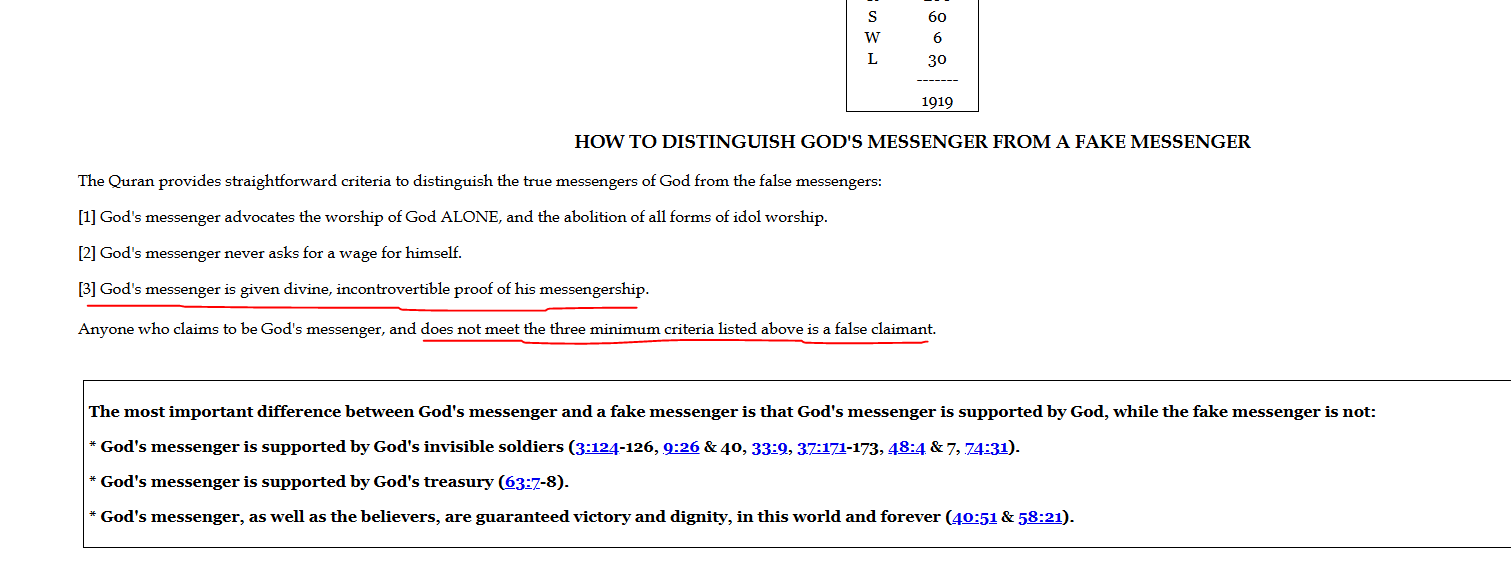
This is the standard. Messengers are authenticated - not by self-generated doctrines explaining why authentication is unavailable, but by signs that demonstrate divine authority independently of the claimant's own testimony. Alban's attempt to argue that such authentication is no longer possible is not a theological position derived from the Quran. It is a defense mechanism for the absence of any proof to present.
Even Rashad himself confirms this standard towards the end of Appendix 2:
One more absence is worth recording. Rashad's own subtitle over 2:106 reads "The Ultimate Miracle: The Quran's Mathematical Code" - the ultimate miracle, the greatest of them. Nowhere in Rashad's works is the code called the last miracle until the End of the World. That framing is Alban's invention, stitched onto Rashad's vocabulary: "ultimate" describes rank, not a closed door - and 2:118 holds that door open in the present tense.
V. The Arithmetic Is a Constructed Result
The sums themselves are correct: 38+1+15+9+2+106 = 171 = 19x9, 17+59 = 76 = 19x4, and 171+76 = 247 = 19x13. Arithmetic is not the problem. Authorship is.
First, the anchor is a misspelled name. 171 equals "the gematrical value of Alban Fejza" only under the Arabic forms Alban invented for himself - البن (83) and فاز (88) - the same forms dismantled on The Name Manipulation Problem: the first drops the Hamza and an alif of his actual name, and the second is not a rendering of "Fejza" at all but a different word entirely. Under every defensible correct rendering documented there - ألبان with فيزا, فيزة, فيجا, or فيجزة - the totals are 182, 186, 178, and 189. Not one of them is a multiple of 19.
Second, the "third" multiple is automatic. Two multiples of 19 always add up to a multiple of 19 - that is elementary arithmetic, true of any two such numbers. Alban even concedes it mid-sentence: "it follows logically that adding all the sura and verse numbers in the diagram should again give a multiple of 19." He then presents the entailed total, 247, as though it were an additional wonder. It is not a third confirmation. It is the first two, added together.
Third, the verses were chosen by the author, not fixed by the Book. 334 of the Quran's 6,234 numbered verses have sura and verse numbers that sum to a multiple of 19 - roughly one in nineteen. More than 2.1 billion different three-verse selections total a multiple of 19, and pairing any of them with any of the 334 single verses yields a "diagram total" that is also a multiple of 19 - roughly 700 billion four-verse diagrams like his exist inside the Quran, waiting for anyone to draw boxes around them. The Quran's mathematical miracle lives in counts fixed inside the preserved text itself - letters, words, suras, and verse numbers that no human chose. A total computed over a reading list the claimant assembled, anchored to a misspelling of his own name, is not embedded in anything. It is a constructed result.
VI. The Shield That Defeats Itself
Clarification 12 exists to close a door: if no miracle can come after the code, then Alban's lack of one stops being a disqualification and becomes, in his telling, obedience to scripture. But the same Clarification quietly walks back through the door it just closed - it offers a numerical "sign" of its own, presenting 171 as the value of Alban's name and as heaven's endorsement of his "discovery."
He cannot have both. If no sign can come after the Mathematical Miracle, then his 171 signifies nothing, by his own doctrine. If his 171 is a sign, then signs can still come, and the flowchart refutes itself. Either way, Clarification 12 collapses - and what remains is a man with no proof, holding a doctrine whose only function is to make proof unnecessary. The Quran already answered him, in the very verse he rewrote: "Do you not recognize the fact that GOD is Omnipotent?"
See also the pattern across his material: The Underlying Issue.