
Clarification 22 - Seven Methods, One Borrowed Answer
Part of Alban Fejza: Refutations - The "Clarifications"
I. His Conclusions, and How He Reaches Them
Clarification 22 opens with Isaac Newton, quoted saying he computed 2060 "not to assert when the time of the end shall be, but to put a stop to the rash conjectures of fanciful men who are frequently predicting the time of the end." Alban then predicts the time of the end - to the year (2280), the season (fall), the weekday (Friday passing into Saturday), the o'clock (19:00 in Mecca), and the window (one of "the last 19 Fridays" of 2280) - via "seven different methods." The year is correct, and it was not discovered here: 2280 CE / 1710 AH is Rashad Khalifa's published Appendix 25 result, and Alban concedes as much in passing - "this last method with the Quranic Initials was the method used by Rashad Khalifa." The other six are billed as independent confirmations. This page audits them one at a time, because this Clarification is the series' purest specimen of its habit: Rashad's truth as the load-bearing wall, Alban's inventions as the paint.
II. A Borrowed Footnote, With the Messenger Deleted
The preamble re-reads 31:34 as "two things impossible to know, three things very hard" - death's time and place impossible; the womb, the weather, and the End merely difficult, and now solved by ultrasound, supercomputers, and Alban. That partition is not his. Rashad's footnote on 31:34 reads: "God reveals His knowledge whenever He wills. We learn from this verse that we may be able to predict the rain, and the gender of the fetus. But we can never know the time or place of death. In accordance with 72:27, God has revealed the end of the world through His Messenger of the Covenant. See 15:87, 20:15, and Appendix 25." Alban's preamble is this footnote with its third sentence amputated: the tiers kept, the Messenger deleted, the disclosure re-assigned to himself. Note also what his own partition costs him: if the time of death is "impossible to know," then a man publishing the death-hour of the entire final generation - Friday, 19:00, Mecca time - has violated his own axiom in his own document. The sound half of the preamble - that the believers are not caught off guard - is Rashad's doctrine: 20:15 keeps the Hour "almost hidden" (almost - the Quran's own signal of eventual disclosure, under Rashad's header "End of the World"), and 6:47 speaks of retribution coming "suddenly, or after an announcement." Even here the citations wobble: his list offers 2:107, which is about God's kingship (the Hour-comes-suddenly verse is 12:107), and "40 years in the desert (5:25)" - the forty years are in 5:26.
III. Method 1 - The Third Day
Method 1 converts Luke 9:22 into arithmetic: Jesus "promised that he will come back on the third day," days are a thousand lunar years (32:5), so the third day began around 1973. But Luke 9:22 is the Gospel's resurrection prophecy - "be killed, and on the third day be raised" - fulfilled, in the Gospel's own narrative, three literal days later. It is not a return schedule, and re-denominating a fulfilled three-day prophecy into three millennia is precisely the kind of literal-mystic mishandling of Jesus' speech that manufactured trinitarianism. The Quran's own position makes the premise unusable anyway: "they never killed him, they never crucified him - they were made to think that they did" (4:157) - the killed-then-raised sequence Method 1 computes with is one the Quran disputes at its root. And a "day" of 970 years makes "the third day" an interval running from 1973 to 2943 - a prediction nine and a half centuries wide, confirming nothing. What the method actually accomplishes is an accident of honesty: it lands the opening of its window at 1973-1974 - the years God's code was unveiled. The Quran's real Jesus-to-End connection is already published in Rashad's 43:61 footnote: the world ends 2280 years - 19 x 120 - after the birth of Jesus, with 570, the years from Jesus' birth to Muhammad's, dividing both the solar and lunar counts. No return required; Rashad is explicit that Jesus is not coming back to this world. And the "awaited one" vacancy the method needs was filled, publicly, through Gabriel:
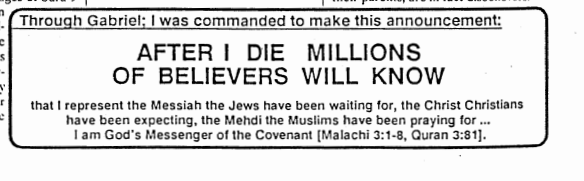
September 1989, Submitters Perspective: "Through Gabriel; I was commanded to make this announcement: AFTER I DIE MILLIONS OF BELIEVERS WILL KNOW that I represent the Messiah the Jews have been waiting for, the Christ Christians have been expecting, the Mehdi the Muslims have been praying for... I am God's Messenger of the Covenant [Malachi 3:1-8, Quran 3:81]." The role every denomination awaits is announced and occupied - which forecloses, in one sentence, the separate returning-Jesus figure Alban's method exists to schedule.
IV. Methods 2 and 3 - Concurrent Time, Billed Serially
Method 2 sums "all the resurrection cases, without exception": the murder victim of Moses' time (same day), the man of 2:259 (100 lunar years), "Lazarus (four days)," and the Sleepers (300 years) - total, he says, 2197. Add his printed items and you get about 397. The 2197 exists only because the Sleepers' single 300-year sleep is silently multiplied by seven - seven men who slept the same three centuries, billed as twenty-one serial ones. And the list breaks its own premise twice: Lazarus is in the Gospel of John, not in the Quran - inside a method defined as "the Quran mentions... none of those cases are there in the Quran by accident" - while the Quran's own resurrection roster is quietly dropped: Abraham's four birds (2:260) and the dead that Jesus revived by God's leave (3:49, 5:110), cases with no stated durations, which is exactly why a "total of all cases" can never be computed. Then the number 2197 - a sum of durations from four unrelated centuries - is read as the calendar year 2197 CE, as though the pile of years began at the birth of Jesus. No epoch is stated anywhere. A magnitude was mistaken for a date.
Method 3 repeats the seven-fold trick with theology attached: resurrecting seven men after 300 years is "equally as hard" as resurrecting one man after 2100, therefore the End comes 2100 years after the cave. The Quran addresses that arithmetic by name: "The creation and resurrection of all of you is the same as that of one person" (31:28). Difficulty does not multiply for the Almighty - seven times 300 is a human ledger imposed on the One who says "Be." The Quran gives the stay as 300 years, increased by nine (18:25, under Rashad's header "[300 + 9]"); no verse multiplies it by the head count, and the cave's entry date is unknown even to Alban ("historians don't know exactly"), leaving a "perfect method" with no working parts. Meanwhile the real Sleepers-to-End connection was published decades ago, in Rashad's footnote on that very verse: "discovering the end of the world was predetermined by the Almighty to take place in 1980 AD (1400 AH), 300 years (309 lunar years) before the end of the world." The Sleepers' number measures from the unveiling of the End through God's Messenger of the Covenant to the End itself - 1980 + 300 = 2280, exact, anchored, and 19-verified. Alban's version multiplies the number by seven and hangs it from a date nobody knows. The photocopy mangled the original.
V. Methods 4 and 5 - The Odometer
Methods 4 and 5 sum time-periods mentioned in the Quran - years in one pass, then years, months, and days in a second - and declare each total "1709 Hijri years," ending the world at 1710 AH. First, the premise: no verse says the Quran's mentioned durations, added together, equal the world's remaining lifespan - let alone counted from the Hijra, an epoch with no connection to Joseph's harvests or Noah's ministry. Second, the presentation: add the numbers as printed and you get about 1666, not 1709; the totals only emerge through an unshown conversion of the solar-year items into lunar years (his sinina-versus-'aam lexicon - which does have one genuine Rashad anchor, the 18:25 footnote's 300-solar-equals-309-lunar, and no anchor anywhere else). But grant the premise, the epoch, and the conversion, and the totals still stand on three fudges. The man of 2:259 was dead one hundred years - "You have been here a hundred years... look at your donkey" - one century, shared by man and donkey; Alban bills it twice, "100 for the man + 100 for the donkey," the same concurrent-time-billed-serially move as the Sleepers. Remove the phantom century and both methods land at 1610 AH - the world ends around 2183, and the "confirmation" confirms a different doomsday. Noah's fifty is worse: 29:14 says he stayed "one thousand years, less fifty" - 950 elapsed; Alban books the subtracted fifty as a positive period, billing a subtrahend as elapsed time. And Method 5 adds 9:36's four sacred months on top of that verse's own twelve - four months that are inside the twelve - while omitting the seven nights that stand beside the eight days it counts from 69:7, and stocking the ledger with recurring laws (divorce cooling-offs, widows' interims, oath fasts) under a rule that admits only "years which really happen." Each fudge is load-bearing. A method that needs a donkey's phantom century, a negative booked as a positive, and a double-counted Ramadan-season to reach its target is not confirming Appendix 25; it is leaning on it.
VI. Method 6 - The Felt-Time Ledger
Method 6 sums what the resurrected will say their lives felt like - "no more than a day" - as if felt time were a measurement. Rashad's renderings state the category: "they will feel as if they lasted in this world one hour of the day" (10:45); "they will feel as if they lasted one evening or half a day" (79:46). Perceptions of brevity, summed across six different groups of speakers, into a cosmic odometer - with no epoch, again, so that a 2279-year "total" can impersonate the calendar year 2280. And the roster of "all the cases, without exception" is rigged at every slot. One verse above his first entry, 20:103 records the testimony "You have stayed no more than ten days" - excluded (include it and the total explodes past eleven thousand). 23:113's "a day or part of a day" - excluded. 17:52's "a short while" - excluded. His second "one day" citation, 20:113, reads: "We thus revealed it, an Arabic Quran..." - there is no day-testimony in it; the citation is fabricated, the series' second invented reference after 80:60. 79:46 offers "one evening or half a day" - he pockets the evening and buries the 485-year alternative. The units are inventions stacked three deep - "Quranic hours are Sundial hours, always 1/12," "a Quranic evening is when sun altitude is 0° to -18°, 1/10 of 180°" - modern astronomical twilight smuggled into God's mouth. And the formula betrays its own author: he defines the evening as one-tenth of night, and a heavenly night is 485 years - one-tenth is 48.5. He wrote 97, a tenth of the full day, because 48.5 lands the total at 2231 and misses. Even his own fabricated unit had to be misapplied to arrive. A last touch of providence: one of the four verses he sums, 46:35, sits under Rashad's header "God's Messenger of the Covenant."
VII. Method 7, the Season, and the O'Clock
Method 7 - the initials' gematrical values totaling 1709, ending the world at 1710 AH - is real, exact, and entirely Rashad's: Appendix 25, where the total is anchored by the signatures Alban never once mentions: 1710 = 19 x 90, 2280 = 19 x 120, discovered at the divinely predetermined juncture of 1400 AH / 1980 AD, the Sleepers' 300 solar years before the End. Those divisions are the discovery's fingerprint, and their absence from this Clarification is the tell of a borrower who cannot cite the serial number. The footnote printed over his own source passage settles the authorship: "15:85-88: One of the functions of God's Messenger of the Covenant is to deliver the Quranic assertion that the world will end in AD 2280 (20:15, 72:27 & Appendix 25)." Delivering the End-date is an office, the office is named, and the name is not Alban's. One more inconsistency: in Clarification 21 these same letters counted crises from Alban's private 2005 epoch; here they count the world's age from the revelation. Two epochs for one alphabet, chosen per video.
The trimmings then defeat each other. The season rests on the camel of 81:4 - a verse that reads, in the translation he claims to follow, "The reproduction is halted" (no camel, no ten months, no season - dismantled in Clarification 21), plus three parables, one of which, 10:24, says the judgment comes "by night or by day" - his own citation forbidding his own o'clock. The weekday rests on a pun: 34:30's "specific day" means appointed, not named after a weekday - the verse's point is that you cannot move it by one hour, not that its calendar slot is published. His Saturday prooftext, 16:124, carries Rashad's header "The Sabbath Abrogated" and states the Sabbath was decreed "only for those who ended up disputing it" - a rescinded ordinance drafted into hosting the resurrection, which 36:49 actually schedules as "one blow... while they dispute," morning unspecified. The "last 19 Fridays of 2280" - the sacred count repurposed as branding - run from August 27 to December 31: four of the nineteen fall in the summer his own camel-season excludes. And the Friday sunset in Mecca "happens to be at 19:00" only in June and July; through his own fall window it runs 17:38 to 18:41. The hour contradicts the season, the season contradicts his own prooftext, and the whole schedule ends in a pre-packed retreat: the exact Friday "remains unreliable" because the moon will split - "So, after all, it is true that only God knows the exact date." That sentence sits three lines below the 19:00 appointment it revokes. The Quran had said it first: "It will not come to you except suddenly" (7:187).
VIII. What Survives - and What the Rest Is For
Peer review, given in full. The year is true: 2280 CE, 1710 AH - Rashad's Appendix 25, sealed with 19 x 120 and 19 x 90. The Sleepers do point to the End - through Rashad's 18:25 footnote, 1980 + 300, not through a sevenfold sum from an unknown date. The believers are indeed not caught off guard - per the 31:34 footnote whose tiers Alban borrowed and whose Messenger he deleted. Method 7 is sound because it is Appendix 25, and Alban says so himself. Even the farewell commandment list is real Quran and good counsel - with one manufactured entry: "Ignore unimportant information" appears nowhere in 17:36. What 17:36 does say is the epitaph of this entire Clarification: "You shall not accept any information, unless you verify it for yourself." We verified. One method is Rashad's, borrowed whole. Two mistake magnitudes for dates, having no epoch at all. Two hang on a donkey's phantom century and a subtracted fifty booked as elapsed time. One runs on a fabricated citation, three excluded testimonies, and a tenth of the wrong unit. And the schedule ends with its author admitting only God knows the date - three lines after publishing the o'clock. Seven methods: one answer that was always Rashad's, and six demonstrations of why the verse he closes with was needed: who is more evil than one who says, "I have received divine inspiration," when no such inspiration was given to him? (6:93)
See also the pattern across his material: The Underlying Issue.