The Bahai Faith: A Rational Examination
Who Are the Bahais?
The Bahai Faith is the youngest of the religions that claim descent from the line of Abraham. It was born in nineteenth-century Persia, out of Shia Islam, in two stages.
The first stage began in 1844 in Shiraz, when a young merchant named Siyyid Ali-Muhammad declared himself the Bab - "the Gate." He emerged from the Shaykhi school, an esoteric current within Twelver Shiism preoccupied with the imminent appearance of the Hidden Imam. The Bab's claim escalated in steps: first the gate to the awaited Imam, then the awaited one himself, and finally an independent Manifestation of God bearing a new scripture - the Bayan - which he declared to abrogate the Quran. His movement spread rapidly, collided with the Persian state and clergy, and was drowned in blood. The Bab was executed by firing squad in Tabriz in 1850, at the age of thirty. Before dying, he appointed a young follower named Mirza Yahya, titled Subh-i-Azal, as the head of his community, and he promised the future coming of a greater figure he called He Whom God Shall Make Manifest.
The second stage belongs to Subh-i-Azal's older half-brother, Mirza Husayn-Ali Nuri, known as Bahaullah - "the Glory of God." A nobleman's son and a committed Babi, he was exiled to Baghdad after an attempt on the Shah's life by some Babis in 1852. In 1863, in a garden outside Baghdad, he privately declared to a handful of companions that he was the one the Bab had promised. The declaration became public over the following years, the community split violently between the two brothers, and Bahaullah's faction prevailed. Exiled further to Constantinople, then Adrianople, then the prison city of Akka in Ottoman Palestine, Bahaullah spent his remaining years producing a large body of writings - most centrally the Kitab-i-Iqan (Book of Certitude) and the Kitab-i-Aqdas (Most Holy Book), his book of laws, written in 1873. He died near Akka in 1892.
Leadership then passed to his son Abdul-Baha (died 1921), appointed as authorized interpreter; then to Abdul-Baha's grandson Shoghi Effendi, appointed "Guardian of the Cause" (died 1957); and finally, since 1963, to an elected nine-man council called the Universal House of Justice, seated on Mount Carmel in Haifa. Bahais today number several million, spread across nearly every country, and they are, it must be said plainly, persecuted with real cruelty in Iran - a persecution nothing in this article excuses or diminishes.
The teachings are attractive on their face: one God; one human family; religion revealed progressively through a chain of Manifestations - Abraham, Moses, Zoroaster, Buddha, Krishna, Jesus, Muhammad, the Bab, Bahaullah - each bringing the measure of truth his age could bear; the oneness of all religions; the equality of men and women; the independent investigation of truth; the harmony of science and religion; universal peace. The number nineteen runs through Bahai practice: a calendar of nineteen months of nineteen days, a nineteen-day fast, community feasts every nineteen days, a religious tax of nineteen percent.
The Bahai position on Islam should be stated carefully, because it frames everything that follows. Bahais affirm that the Quran is the authentic, uncorrupted word of God. They affirm that Muhammad was a true Manifestation. But they hold that his dispensation has ended - that the Quran's laws are abrogated, and that the word of God for this age is the word of Bahaullah. The Quran, in their system, is a true book whose time has passed.
The purpose of this article is not to mock Bahais, nor to catalogue personal failings, nor to trade in the hostile gossip that surrounds every religious minority. Most Bahais are sincere, warm, idealistic people, and the ideals themselves - peace, unity, service - are not on trial. The claims are. A man claimed that God speaks through him and that the Quran's authority is dissolved. That claim is either true or false, and it is large enough to deserve a serious answer. Since Bahais themselves hold the Quran abrogated, this examination will not rest its weight on Quranic proof-texts alone. It will rest on logic, on the Bahai Faith's own scriptures, and on its own recorded history - the three courts no claimant can recuse.
How Should a Claim of Revelation Be Tested?
Before examining the Bahai claim, we should fix the standards - and they should be standards the Bahai Faith itself accepts.
First: consistency. Truth does not contradict itself. A revelation from an omniscient God cannot assert one thing in its books and the opposite in its conduct, cannot legislate a rule and be founded on that rule's violation, cannot proclaim a principle and institutionalize its negation. Wherever we find such a contradiction, something human has been signed in God's name.
Second: fulfilled prophecy. The Quran states the principle in a single line:
[72:27] Only to a messenger that He chooses, does He reveal from the past and the future, specific news.
The Bahai writings claim this credential constantly; Bahai teachers present their founders' predictions as proof of divine knowledge. Very well - the credential cuts both ways. A specific claim made in God's name must come true on its stated terms. When it fails, the honest conclusion is not that God requires a recalculation. It is that the claim was not from God. And a corollary follows that will matter greatly below: a prophecy from God never needs to be edited after the result is known.
Third: verifiable evidence. A claim of this magnitude requires something beyond eloquence and assertion:
[40:78] We have sent messengers before you - some of them we mentioned to you, and some we did not mention to you. No messenger can produce any miracle without GOD's authorization. Once GOD's judgment is issued, the truth dominates, and the falsifiers are exposed and humiliated.
The Quran models this itself: it issues an open, testable challenge to all comers (2:23, 17:88) - produce something like it. Evidence you can check is the signature of a divine claim; evidence you must simply trust is the signature of a human one.
Fourth: the Quranic ceiling - which Bahais themselves accept as God's word. Bahais affirm the Quran is authentic revelation. The Quran states:
[33:40] Muhammad was not the father of any man among you. He was a messenger of GOD and the final prophet. GOD is fully aware of all things.
And it defines what comes after the final prophet:
[3:81] GOD took a covenant from the prophets, saying, "I will give you the scripture and wisdom. Afterwards, a messenger will come to confirm all existing scriptures. You shall believe in him and support him."
The Quran's own architecture, in other words, is precise. Prophethood - the office that brings new scripture and new law - is sealed with Muhammad. What God's covenant provides after him is a messenger who confirms what exists. Any man who arrives carrying a new holy book that abrogates the Quran is claiming exactly the office 33:40 closed. The Bab and Bahaullah each did precisely that - each brought a new book of laws announced as superseding the Quran. By the plain text of a scripture Bahais themselves certify as God's uncorrupted word, both claims are disqualified at the door. The standard Bahai response is to reread "seal of the prophets" as a decoration - a "seal of approval" rather than an ending. The reader can weigh whether "seal" placed at the end of a line of prophets, in a book that elsewhere calls itself complete, means anything other than what it says. But notice what the maneuver concedes: the Bahai claim can survive its own certified scripture only if that scripture does not mean what it plainly says. That is not a foundation. That is a leak in the foundation, patched from inside.
And the leak runs deeper still, because the founders themselves, writing and praying as the Muslims they publicly were, repeatedly affirmed the seal in its plain sense. Bahaullah's own Persian and Arabic works bless Muhammad as the one "by whom Messengership and Prophethood was terminated" (Ishraqat, p. 293 of the Persian edition; the same affirmation stands in Ma'ida-yi Asmani, vol. 4, p. 260, and Kitab-i-Badi, p. 293 - collections the faith has never officially translated). The finality the Bahai Faith must explain away is one its own founder wrote down.
With the standards fixed - consistency, fulfilled prophecy, verifiable evidence, and the ceiling set by a book Bahais themselves call true - we can proceed. We will find that the Bahai Faith fails all four, and fails them on its own documents.
The Logic of Progressive Revelation
The doctrine of progressive revelation is the Bahai Faith's intellectual centerpiece, so let us state it at full strength. One God has one religion. He educates humanity as a wise teacher educates a child - in stages, through successive Manifestations, each renewing the eternal truths and adjusting the social laws to the capacity of the age. Religions differ only because their ages differed and because their followers corrupted what was given. Seen this way, religious diversity stops being a scandal and becomes a curriculum, and Bahaullah is simply the teacher for today's classroom. It is an elegant idea, and its elegance is the engine of most conversions. It deserves a careful answer rather than a dismissal. Here is one, in three steps.
1 - The oneness of religions is achieved by rewriting them
The religions the theory claims to unify hold doctrines that are not merely different but mutually exclusive - about God, the soul, salvation, and law. Logic gives only three options: at most one such set of claims is true as taught, or none is, or the claims do not mean what their own adherents and texts say they mean. The Bahai system takes the third path for every religion in the chain: each prior faith is declared true - after its distinctive teachings are reclassified as symbol, later corruption, or expired law, and its self-understanding is overruled. Buddhism is affirmed while its actual metaphysics is discarded; the Quran is affirmed while its declaration of a final prophet is reread; every scripture is honored and none is permitted to mean what it says. But a theory that can only unify religions by falsifying each of them has not discovered their unity. It has manufactured it. The "oneness of religion" turns out to mean: all religions agree with the Bahai Faith once the Bahai Faith has finished editing them. That is not a discovery about the world's faiths. It is a mirror.
2 - The system is built to be unfalsifiable
Notice the role the living Manifestation plays in the machinery. Whatever in previous scripture supports the new claim is literal. Whatever contradicts it is symbolic, or corrupted, or dispensationally expired - and the Manifestation of the day is the sole authority on which is which. The consequence is structural: no possible evidence could ever count against the claim. A fulfilled expectation confirms it; a contradicted text is reinterpreted by it; a failed expectation becomes a "test of the believers." A system armored in advance against every conceivable disproof is not a strong theory. It is not a theory at all. Knowledge is the kind of thing that risks being wrong; the Manifestation doctrine is engineered never to risk anything. The Quran, for contrast, plants its flag on falsifiable ground - a standing literary and mathematical challenge (17:88), specific counts anyone may check. One system invites testing; the other defines testing away. That asymmetry alone tells you which kind of claim you are dealing with.
3 - The thousand-year rule, and the nineteen-year exception
The incoherence stops being abstract and becomes a dated, quotable contradiction in Bahaullah's own book of laws. The Kitab-i-Aqdas legislates how to treat the next claimant:
Kitab-i-Aqdas, paragraph 37 - "Whoso layeth claim to a Revelation direct from God, ere the expiration of a full thousand years, such a man is assuredly a lying impostor."
Hold that sentence against the faith's own chronology. The Bab declared a Revelation direct from God in 1844. Bahaullah declared a Revelation direct from God in 1863. The gap is nineteen years. The interval between the Quran and the Bayan had itself been some twelve centuries; the interval between the Bayan and Bahaullah was less than the span of a single generation - and then, the moment Bahaullah's claim was established, the gate slammed shut behind him for a thousand years, with "lying impostor" stamped on whoever approaches it next.
The Bahai answer is that the Bab's dispensation was always meant to be brief, a herald's interlude. But that concedes the point rather than answering it: it means the interval between Manifestations is whatever the current claimant needs it to be - twelve centuries when explaining the past, nineteen years when justifying the founder, ten centuries minimum when protecting him from successors. A rule that flexes for one man and hardens for everyone after him is not a divine law. It is special pleading in statute form, and it is written in the book Bahais call most holy. By the Aqdas's own arithmetic, applied without favoritism, Bahaullah is what the Aqdas says the next early claimant would be.
The Bab: The Foundation of the Chain
Everything in the Bahai Faith stands on the Bab. Bahaullah's entire claim is that he is the one the Bab promised; if the Bab was not a Manifestation of God, there is no promise to fulfill and the chain never starts. So the Bab's claim deserves to be examined first, and on its own evidence.
The origin: a dream of blood
What was the source of the Bab's revelation? We do not need hostile witnesses; the Bab described it himself, in an account his own tradition has preserved with reverence. In the year before his declaration, he had a dream. In it he saw the severed head of Imam Husayn, the martyr of Karbala, hanging from a tree, blood dripping from the lacerated throat - and in the dream he approached, gathered drops of that blood in his hands, and drank them. In his own words: "With feelings of unsurpassed delight, I approached that tree and, stretching forth My hands, gathered a few drops of that sacred blood, and drank them devoutly. When I awoke, I felt that the Spirit of God had permeated and taken possession of My soul." (the Bab's account in a Tablet of 1260 AH - 1844 - preserved and published in the faith's own literature). He identified the spirit animating his mission as "the direct consequence" of that dream.
Consider what is being claimed, and on what basis. The abrogation of the Quran - a scripture Bahais themselves certify as God's word - is being announced on the strength of a private dream that no other human being can examine, saturated in the devotional imagery of the very Shia milieu that formed the dreamer. A Shaykhi mystic, steeped from youth in Karbala mourning rites and the expectation of the Hidden Imam, dreams the central image of that culture and wakes convinced he carries the Spirit of God. There is no external sign here, no fulfilled test, no verifiable anything - only an experience, reported by the one man who benefits from it, of a kind that every religious culture in history has produced in abundance. When the Quran describes revelation, it points outward, to evidence and authorization (40:78). When the Bab describes his, he points inward, to a dream of drinking blood. The entire Bahai edifice - the Bayan, Bahaullah, the Aqdas, the House of Justice in Haifa - balances on that dream.
Nor is this peculiar to the Bab. Bahaullah's own account of his commission, addressed to the Shah of Persia and enshrined in his scripture, runs: "O King! I was but a man like others, asleep upon My couch, when lo, the breezes of the All-Glorious were wafted over Me, and taught Me the knowledge of all that hath been." (Epistle to the Son of the Wolf, quoting his Tablet to Nasiri'd-Din Shah). Set the two testimonies side by side: one founder drinks blood in a dream; the other receives the knowledge of all things in his sleep. The entire chain of authority on which the Quran is declared abrogated consists of two private sleep experiences, reported by their sole beneficiaries, checkable by no one.
And what did the new revelation initially claim to be? Not a new religion. The Bab's first and central book, the Qayyum al-Asma of 1844, presents its author as the devoted servant of the Hidden Imam of Shia Islam - and the faith's own histories preserve the evidence. Abdul-Baha's historical work reproduces the Bab's address to the Hidden Imam: "O Remnant of God, I am wholly sacrificed to Thee; I am content with curses in Thy path, and I crave naught but to be slain in Thy love" (Qayyum al-Asma, quoted in A Traveller's Narrative, p. 3). The faith's canonical history records the testimony of his own first disciples: "I bear witness that He whose name is Ali-Qabl-i-Muhammad is the servant of the Baqiyyatullah" - the servant of the Hidden Imam (The Dawn-Breakers, p. 144). Servant of the Imam in 1844; the promised Imam himself by his trial in 1848; by the end, an independent Manifestation of God whose book abrogated the Quran. Each step up was taken as the movement's momentum allowed, and each step contradicted the station publicly claimed at the one before. A divine station is a fact. This is a trajectory - and their own books preserve every rung of the ladder.
The concealments and the denials
The ladder was climbed under cover. From the very first weeks, the Bab bound his followers to concealment: his directives of December 1844 order his first disciple not to reveal his identity and to observe taqiyyah - dissimulation - and in other letters he declares, "Taqiyyah is my faith and the faith of my forefathers" (the Bab's own directives, documented from his letters in the academic study Resurrection and Renewal, pp. 56-58); in his Seven Proofs he states plainly, "Since I was aware of the limits of the public, I ordered the concealment of my name" (Dala'il-i-Sab'ih, p. 29).
Concealment escalated to public denial, and the faith's own canonical history preserves the scene. Returned to Shiraz under arrest, the Bab mounted the pulpit of the Vakil Mosque at Friday prayer and declared before the congregation: "The condemnation of God be upon him who regards me either as a representative of the Imam or the gate thereof. The condemnation of God be also upon whosoever imputes to me the charge of having denied the unity of God, of having repudiated the prophethood of Muhammad, the Seal of the Prophets..." (The Dawn-Breakers, ch. 8). Read it twice. The man whose mission began with the claim to be the Gate calls down God's condemnation on anyone who believes he is the Gate - and affirms Muhammad, in the same breath, as the Seal of the Prophets, the very finality his later claims required him to overturn. At his Tabriz examination the record continues: a written submission in which, per the surviving documents, he disavows "any superhuman claim" and repents of any divine mission ascribed to him (preserved in the scholarly archive Materials for the Study of the Babi Religion, pp. 256-259 - where the clerics' verdict also survives, deferring his execution over "a doubt as to thy sanity of mind").
Bahai historiography answers that these denials were wisdom - strategic concealment before the appointed hour. Accept the defense and see what it purchases: a Manifestation of God who, in a mosque, at Friday prayer, invoked God's curse upon his own believers' belief in order to walk free. There are two readings of a man who publicly renounces his mission under pressure and resumes it in safety, and neither of them is prophethood. The messengers of God in every scripture proclaim under the sword. This claimant cursed his followers' faith to escape custody, then climbed the next rung of the ladder. His followers call the pattern concealment; the plain word for solemn public denial of one's own divine commission is a different one.
The book built on nineteen that died unfinished
The Bab's principal scripture, the Bayan, was consciously architected on the number nineteen: it was designed as nineteen unities (vahids) of nineteen chapters each - 361 chapters. This was the plan of the man his followers call a Manifestation of God, in the book they call his most important work.
He did not finish it. The Persian Bayan stops partway through the ninth unity of the nineteen. The Arabic Bayan reaches eleven. The Bab was executed with his own nineteen-structure standing at less than half its declared frame, and the completion was deferred to the promised one to come - who never completed it either; Bahaullah set the Bayan aside and wrote his own books instead. So the one scripture in this entire story that was deliberately built on nineteen exists, permanently, as a monument to an attempted nineteen that failed. We will see in the next section why that fact is fatal to a specific Bahai argument.
And note a stranger fact about the Bayan's fate. In the century and three quarters since the Bab's death, the institution that rules his successor faith has never issued an official translation of the Bayan into English or any Western language. The book of the Gate himself - the second person of the Bahai chain, a Manifestation of God on their telling - is functionally withheld from the world's believers, who are simultaneously taught the principle of independently investigating truth. One provision of the Bayan, at least, the Bahai writings do acknowledge, because the Kitab-i-Aqdas had to abrogate it: the Bayan commanded the destruction of all books except those written in defense of the Cause (acknowledged in the official Notes to the Kitab-i-Aqdas, note 109 on paragraph 77). Nor was that law an outlier. The Aqdas, in the very act of repealing them, catalogues its predecessor's decrees: the Bayan had forbidden the believers to ask questions (repealed at para. 126: "In the Bayan it had been forbidden you to ask Us questions"); had restricted travel (para. 131); had outlawed marriage with anyone outside the faith (para. 139: "It is unlawful to enter into marriage save with a believer in the Bayan"); had set a fine of nineteen mithqals of gold for causing sadness to another (para. 148). The academic study of the Bayan's holy-war doctrine adds the Bab's exhortation to a future Babi king to leave upon the earth, if possible, none but the people of the Bayan. Books destroyed, questions banned, marriage sealed, unbelievers cleared from the earth - this is the dispensation Bahais canonize as a divine springtime, described in the repeal notices of their own Most Holy Book. The reader is invited to reconcile it with "the independent investigation of truth," or with the character of a wise divine educator, or with either.
The timeline he set, and the successor he chose
Two more of the Bab's own decisions remain, and they close the case from inside.
The timeline. In the Persian Bayan, the Bab pointed his community's expectation for He Whom God Shall Make Manifest toward dates expressed in the letter-values ghiyath and mustaghath - the years 1511 and 2001 of his era (Persian Bayan 2:16). Bahaullah declared himself nineteen years after the Bab's declaration. The objection is not a modern discovery; it was raised by the Babis themselves, immediately - we know this because Bahaullah answers it in his own published writings, rebuking those who, in his words, murmur against "the premature birth of His light" (Gleanings from the Writings of Bahaullah, no. 50). His answer to the timeline objection was not a demonstration that the timeline permitted him. It was a rebuke of those who noticed it did not.
The successor. The Bab appointed one man to lead the community after him: Subh-i-Azal - Bahaullah's own younger half-brother. This is the man the Bab, a Manifestation of God with divine knowledge, chose. And Subh-i-Azal examined Bahaullah's claim with better access than anyone alive - he knew the claimant from childhood, and he knew the Bab's texts as their appointed custodian - and he rejected it as false. The community split. The split turned vicious: mutual accusations of poisoning between the brothers' camps, and followers of Azal in Akka killed by followers of Bahaullah. This is the founding generation of the faith of unity.
Now run the logic, because there is no exit from it. If Subh-i-Azal judged rightly, Bahaullah was an impostor and the Bahai Faith is false directly. If Subh-i-Azal judged wrongly, then the Bab - a Manifestation with divine foreknowledge - handed his religion to the one man who would betray it within a decade, and his dispensation provided criteria so useless that its own appointed head, applying them with maximal knowledge and maximal duty, reached the wrong answer. Either the judge was right, or the one who appointed the judge was not divine. Bahais respond that Azal became a covenant-breaker, misled and eclipsed. But that is not an answer; it is the second horn of the dilemma restated as an insult. The faith's later expectation - that ordinary seekers with no Persian, no access to the Bayan, and no acquaintance with either brother should recognize Bahaullah correctly - stands under the fact that the man best equipped on earth to make that judgment, chosen for the task by their own Manifestation, made it the other way.
The Number Nineteen: Answering the False Dilemma
We now reach the argument this article exists to answer - the one Bahai apologists press against Submitters directly. It deserves to be stated at its full strength, and then taken apart completely.
First, the background. God states in the Quran, of the scripture's own proof:
[74:30] Over it is nineteen.
[74:31] We appointed angels to be guardians of Hell, and we assigned their number (19) (1) to disturb the disbelievers, (2) to convince the Christians and Jews (that this is a divine scripture), (3) to strengthen the faith of the faithful, (4) to remove all traces of doubt from the hearts of Christians, Jews, as well as the believers, and (5) to expose those who harbor doubt in their hearts, and the disbelievers; they will say, "What did GOD mean by this allegory?" GOD thus sends astray whomever He wills, and guides whomever He wills. None knows the soldiers of your Lord except He. This is a reminder for the people.
[74:35] This is one of the great miracles.
Between 1969 and 1974, computer tabulation of the Quran's text carried out through Rashad Khalifa uncovered a mathematical structure running through the book's letters, words, suras and numbers, built on the number nineteen - 114 suras, nineteen times six; the first revelation (96:1-5) nineteen words; the Basmalah's nineteen letters; on and on through counts anyone may verify and no one has overturned. The discovery gave 74:30-35 its meaning: the number, stated in plain text but sealed in function for fourteen centuries, was unveiled precisely when human technology could verify it - and it began performing exactly the functions verse 31 assigns it.
Against this, the Bahai argument runs as follows. The Bab and Bahaullah wove nineteen throughout their religion - a calendar of nineteen months of nineteen days, a nineteen-day fast, a nineteen percent tithe, the Bayan's nineteen-unity design - a full century before Rashad Khalifa. So: did they know of the Quran's nineteen, or not? If they knew, then they discovered it before Rashad, without computers - a sign. If they did not know, then they unknowingly produced a religion patterned on nineteen, exactly as Muhammad unknowingly delivered a nineteen-coded Quran - a sign. Either way, by the Submitters' own logic, the founders of the Bahai Faith are proven messengers of God.
The dilemma sounds forceful. It is empty, and demonstrably so - each horn fails on facts, and the frame itself fails on logic. Here are the four answers.
First answer: nineteen was never hidden - so "knowing of it" proves nothing
The first horn imagines that awareness of the Quran's nineteen before 1974 would constitute a miraculous discovery. But the number was never a secret. It sits in the plain text of 74:30 - "Over it is nineteen" - recited aloud by every generation since the seventh century, followed immediately by a verse announcing that the number is a test with listed functions. Anyone who ever read sura 74 "knew of" nineteen.
Nor did its resonances go unnoticed. Classical commentators recorded, a full millennium before the Bab, the correspondence between the nineteen letters of the Basmalah and the nineteen guardians of Hell - a narration of the companion Ibn Masud states that whoever recites the nineteen-lettered Basmalah is shielded from the nineteen - recorded in Tafsir al-Qurtubi (vol. 1, p. 143), Tafsir Ibn Kathir (vol. 1, p. 65) and al-Suyuti's al-Durr al-Manthur (vol. 1, p. 44), and documented today at hadithanswers.com. The abjad system itself, in continuous use since before Islam, assigns the word wahid - "One," God's own attribute - the value nineteen; Shia letter-mysticism, the Bab's intellectual home, had cultivated such correspondences for centuries. The Bab did not unearth a buried number. He read 74:30 like everyone else, inherited a gematria tradition that had already decorated nineteen with sanctity, and borrowed the number from the very book he claimed to abrogate. If mere attentiveness to nineteen made a man a messenger, the mufassirun of the tenth century were messengers, and every abjad-literate schoolboy of Qajar Persia besides. The first horn dissolves: there was nothing to discover, because the number was never lost. What was hidden was not the number but the structure built on it - and to that we now turn.
Second answer: they produced no nineteen pattern - and the one attempt failed in public
The second horn claims the Bahai founders "unknowingly produced a revelation patterned on nineteen, as Muhammad did." Here the analogy must be held to its own terms, because its own terms destroy it.
What happened with the Quran is this: a man delivered a book over twenty-three years; fourteen centuries later, exhaustive counting of that unaltered text - its letters, its words, its sura and verse numbers - revealed an interlocking structure on nineteen that the deliverer never mentioned, never exploited, and could not humanly have engineered. The pattern is in the composition, discovered after the fact, verifiable by anyone with the text and patience.
For the Bahai parallel to hold, there would need to exist a Babi or Bahai text whose composition - not its decrees, its composition - carries an unplanned nineteen structure discoverable by counting. No such text exists. No Bahai claims one exists. The Kitab-i-Aqdas has no nineteen structure. The Kitab-i-Iqan has none. And the one book in the entire corpus that does relate structurally to nineteen relates to it in the most damning way possible: the Bayan was consciously designed as nineteen unities of nineteen chapters - and its author died leaving it at nine unities in Persian and eleven in Arabic. Count what he actually left: an Arabic Bayan of roughly four hundred and twenty verses, a Persian Bayan of some eight thousand. Where, in either number, is nineteen? A man who deliberately set out to build a book on nineteen, announced the frame, and could not fill it, is not a parallel to a man who never mentioned the number and whose book was found saturated with it fourteen centuries on. He is the exact inverse. Muhammad's case: no intent, perfect structure. The Bab's case: full intent, broken structure. The second horn does not merely fail - it testifies for the other side.
Third answer: decreeing nineteens is legislation, not miracle
What the Bahai founders actually did with nineteen was command it: a nineteen-month calendar, a nineteen-day fast, a feast every nineteen days, a tithe of nineteen percent (Kitab-i-Aqdas, para. 97), a greeting repeated ninety-five times daily - five times nineteen (para. 18). Every one of these is a decree about the number, and decreeing a number requires exactly no divine assistance. Any author, having read sura 74 and admired it, can instruct his followers to meet every nineteen days; a committee could do it; a calendar reformer could do it. Painting the numeral nineteen on the door of your institutions is a choice. The Quran's claim is of a wholly different kind: that the number is woven through the fabric of a fixed text - a text whose every letter was locked in place centuries before anyone could tabulate it - in patterns no author could consciously maintain across twenty-three years of piecemeal revelation under persecution. A decreed nineteen explains itself: the legislator liked the number. An embedded nineteen, discovered after the fact in an unalterable text, explains itself only with difficulty - which is precisely why it can function as evidence, and a calendar cannot. To offer the Badi calendar as an answer to the Quran's code is to confuse a man who writes "19" on a wall with a wall whose bricks number nineteen by another's count. The two facts are not the same species, and only one of them is a sign.
Fourth answer: the Submitter claim was never about priority
Finally, the dilemma misstates the claim it targets. No Submitter argues that Rashad Khalifa is a messenger because he was the first person to mention nineteen. Priority is not the credential and never was. The credential is fulfillment: 74:31 assigns the number five functions - to disturb the disbelievers, convince the Christians and Jews that the scripture is divine, strengthen the faithful, remove doubt, expose the hypocrites - and those functions activated when the structure was unveiled and verified, through the man in whose hands God authorized it (40:78: "No messenger can produce any miracle without GOD's authorization"). The sign is the verifiable structure plus its foretold function - not a race to say a numeral first.
Grant the Bab, for the sake of argument, everything the dilemma wants: full awareness of nineteen's Quranic significance. What follows? Nothing. Knowing of nineteen is not producing the code (he could not - it required counting the whole text), not fulfilling 74:31's functions (his number convinced no Christians and Jews of the Quran's divinity; he was abrogating the Quran), and not authorization (his own nineteen-book broke in his hands). The dilemma's two horns were: "they discovered it" - they did not, for there was nothing hidden to discover and the structure itself they never found; and "they produced it unknowingly" - they produced it neither unknowingly nor knowingly, for there is no nineteen in their compositions and their one deliberate attempt died at nine of nineteen. Both horns are empty. What remains is an irony the apologist should sit with: the number the Bahai Faith wears as jewelry was borrowed from the book it tried to bury - and while the borrowed nineteens sit inert in a calendar, the original nineteen rose out of the buried book, intact and countable, to testify that no one buries the word of God.
The Prophetic Record - and the Edited Book
We established at the outset, with the Bahai writings' full agreement, that fulfilled prophecy authenticates a divine claim - and that a prophecy from God never needs editing after the result is known. Now the record.
Failures in the founders' lifetimes and after
Begin with the prophecy Bahais themselves offer as their strongest, because their strongest is instructive. After the death in 1869 of Fuad Pasha, the Ottoman minister who had engineered Bahaullah's exile to Akka, Bahaullah revealed a tablet declaring, in the voice of God: "Soon will We dismiss the one who was like unto him, and will lay hand on their Chief who ruleth the land, and I, verily, am the Almighty, the All-Compelling." (Lawh-i-Fuad). By the faith's own gloss, "the one who was like unto him" is the Grand Vizier Ali Pasha, and "their Chief" is Sultan Abdul-Aziz. Take the two halves in turn, because they teach opposite lessons.
The testable half failed. "Dismiss" is a specific, checkable claim - and it was also the safest claim available, since Ottoman Grand Viziers of that era were shuffled in and out of office with notorious speed; predicting a vizier's dismissal was scarcely bolder than predicting rain. Yet the one vizier whose dismissal Heaven announced proceeded to hold the office in an unbroken tenure, among the longest of the entire Tanzimat period, until tuberculosis killed him at his post in September 1871. He was never dismissed, never deposed, never disgraced; he died as Grand Vizier, in power. To count this a fulfillment one must read "soon will We dismiss" as "he will remain in office until his death" - the precise opposite of the words.
The vague half is the celebrated one. The Sultan was indeed deposed - five years later, in 1876, in a crumbling empire whose convulsions were the daily conversation of Europe, by plotters who needed no tablet. No time, no manner, no circumstance had been specified: just "We will lay hand on their Chief." And notice how the faith's own apologetic literature handles the pair to this day: it parades the unfalsifiable half and passes in silence over the falsified half - celebrating the tablet's "fulfillment" while offering no date for Ali Pasha's dismissal, because history contains none. A prophecy whose checkable clause failed and whose uncheckable clause is claimed is not foreknowledge. It is the oldest oracle technique on record, and their best case rests on it.
Abdul-Baha's record is of the same kind, and his flagship prophecy sits in the faith's own official compilation of his writings: "The fifth candle is the unity of nations - a unity which in this century will be securely established, causing all the peoples of the world to regard themselves as citizens of one common fatherland." (Selections from the Writings of Abdul-Baha, the "seven candles of unity" tablet). The century in question was the twentieth. It became the bloodiest in the history of the human race - two world wars, industrial genocide, and the atomic bomb - and it closed with no unity of nations and no common fatherland, while the community's long-nursed expectation, sustained by Shoghi Effendi, that at least the Lesser Peace would arrive by the century's end, passed the year 2000 unfulfilled and watched the new century open with wars.
The smaller predictions fared no better. Persia's Jews, it was declared, would embrace the faith: a century and a half on they never did - that community endured as the region's largest outside the Holy Land, and what eventually thinned it was emigration under revolutionary persecution, not conversion. Persia and England were to become complete and lasting friends: the reader may consult any decade of the last hundred years of Iranian-British relations for the verdict.
Each failure has its retroactive repair - the date was symbolic, the peace was "spiritual," the process has merely begun. The reader of this site's examination of Mirza Ghulam Ahmad will recognize the pattern instantly, because it is the universal signature of false prophecy: a specific claim in God's name, a specific failure on the stated terms, and a reinterpretation arriving only after the deadline has passed. A God who knows the future does not miss. Men guessing in His name miss constantly, and their followers explain constantly. But with the Bahai Faith we possess something rarer and more decisive than a missed date. We possess the paper trail of a prophecy being edited.
The case of the rewritten prophecy
The faith's standard introductory textbook - the book placed in inquirers' hands for a century, written with the blessing of the leadership and revised under its supervision - is Bahaullah and the New Era. Its first edition, published in 1923, records Abdul-Baha's own interpretation of the prophecy of Daniel's 1,335 days: that the count pointed to the year 1957, by which time, in his telling, universal peace would be firmly established and the faith's light would have encompassed the world (Bahaullah and the New Era, 1923 edition, p. 212). The passage stood in print, edition after edition, through the 1920s, the 1930s, the 1940s - while the date was still in the future.
Then the date arrived. What 1957 actually delivered was not universal peace. It was the sudden death of Shoghi Effendi, the faith's Guardian, without a successor - the gravest constitutional crisis in Bahai history, as the next section will detail.
And here is the decisive fact: the book was changed. Editions published from 1950 onward quietly rewrote the passage, moving the fulfillment to 1963 by means of a new calculation - one hundred lunar years from Bahaullah's declaration - that appears in no earlier edition and surfaced only when the original date was about to fall due (the reworked passage stands at pp. 250-252 of the post-1950 printings). The year 1963, conveniently, was the year the faith would elect its Universal House of Justice and could declare a milestone achieved. Later printings assure the reader the text remains essentially as written. Set the editions side by side and read them; they differ where it matters most.
And mark who could not have consented to the change: Esslemont died in 1925. The passage rewritten after 1950 was a dead man's firsthand record of Abdul-Baha's spoken words - carried through edition after edition with the Guardian's approval while the date still lay ahead, and altered by the publishers once it lay behind. When the discrepancy is pressed, official answers have reframed the passage as "Mr. Esslemont's interpretation," to be corrected against other texts. It was not an interpretation. It was quotation - of the Master, by an eyewitness, in the faith's own flagship textbook, under the Guardian's imprint - and a new arithmetic of "one hundred lunar years," found in no earlier printing and attributed to no dated tablet, was supplied only after the original answer had failed. The only interpreting was done posthumously, by editors, with the answer key already in hand.
Nor did the eraser stop with Esslemont. A published bibliographic survey of Bahai literature documents the same hand at work across the shelf after 1957: an introductory text whose 1957 printing was dedicated to "The First Guardian, Shoghi Effendi" reappears in 1987 dedicated simply to "The Guardian" - the word "First" gone, along with the earlier edition's statement that Abdul-Baha had provided for a succession of Guardians; and Shoghi Effendi's own declaration that an order divorced from the Guardianship "would be mutilated" - quoted earlier in this article from his 1934 Dispensation - stood at pages 43 to 45 of the 1942 edition of his Selected Writings and is absent from the 1975 edition. When the doctrine failed, the doctrine's paper trail was trimmed to match. The scripture of this faith is not merely defended. It is curated.
Pause on what this means, because nothing in this article is more important. This is not a critic's allegation; it is the faith's own publishing history, verifiable by comparing copies on library shelves. A prophecy attributed to their infallible interpreter was falsified by events and then revised in the record - the numbers reworked after the fact, the failure dressed as fulfillment and pinned to a new date the leadership already controlled. Whatever one calls that procedure, one thing is certain: it is not the behavior of custodians of a message from an all-knowing God. The word of God does not fail; and when it seems to, it is not rescued with an eraser:
[6:115] The word of your Lord is complete, in truth and justice. Nothing shall abrogate His words. He is the Hearer, the Omniscient.
[41:42] No falsehood could enter it, in the past or in the future; a revelation from a Most Wise, Praiseworthy.
One scripture on earth has dared to claim that nothing can be altered in it - and has backed the claim with a mathematical seal over every letter, so that any tampering is instantly detectable. The Bahai textbook could be rewritten in 1950 and the change absorbed without consequence. Try that with a book whose every sura, verse, word and letter is counted. The contrast is the whole argument in miniature.
The Covenant That Ended Itself
Ask a Bahai teacher what distinguishes their faith from every predecessor, and one answer comes back above all: the Covenant - an explicit, written chain of appointed authority, designed by God to make schism impossible. Other religions fractured because their founders left succession vague; Bahaullah, uniquely, left a document. This is the faith's proudest structural claim, so let us read the documents - all of them authoritative Bahai scripture - and then read the history.
Begin with Bahaullah's own will, the Kitab-i-Ahd - the Book of the Covenant, the document the faith celebrates as the first time a Manifestation ever appointed his successor in unambiguous writing. It names his eldest son Abdul-Baha, the Most Great Branch, as head of the faith. And it does something else, less advertised: it names the next heir too. Of his other son, Mirza Muhammad-Ali, the Greater Branch, Bahaullah decrees:
Kitab-i-Ahd (Bahaullah's Book of the Covenant) - "Verily God hath ordained the station of the Greater Branch to be beneath that of the Most Great Branch... We have chosen 'the Greater' after 'the Most Great', as decreed by Him Who is the All-Knowing."
"After the Most Great" - second in the line of succession, chosen, the text says, by the All-Knowing. The same testament proclaims: "Conflict and contention are categorically forbidden in His Book." (Kitab-i-Ahd).
Now open the next constitutional document, Abdul-Baha's Will and Testament, and read what became of the man the All-Knowing chose. Muhammad-Ali is there - as "the Centre of Sedition, the Prime Mover of mischief", of whom the Will declares: "None other transgression greater than his can be ever imagined." (Will and Testament of Abdul-Baha, part one). The faithful are commanded concerning him: "A thousand times shun his company. Take heed and be on your guard. Watch and examine; should anyone, openly or privily, have the least connection with him, cast him out from your midst." (Will and Testament, part two).
Hold the two testaments together, because between them they leave no ground to stand on. Bahaullah, a Manifestation of God with divine knowledge, designated by name, in his own covenant, as second head of his faith - the man of whom his successor would write that no greater transgression than his could ever be imagined. If the charge is true, the All-Knowing knowingly placed the greatest imaginable transgressor one heartbeat from the throne of the Cause, in the very document meant to make the Cause schism-proof. If the charge is inflated, then the Will and Testament - the constitution of the modern faith - is a document of family vendetta dressed in God's name. There is no third reading. And the book in which conflict and contention are "categorically forbidden" begat, within a decade of its author's death, a war of brothers that consumed the founding family. So much for the first link. The Will and Testament then erected the permanent constitution: twin institutions under divine protection. First, the Guardianship - a line of hereditary Guardians drawn from Bahaullah's descendants, beginning with Shoghi Effendi, each Guardian to designate the next: "It is incumbent upon the Guardian of the Cause of God to appoint in his own lifetime him that shall become his successor, that differences may not arise after his passing." (Will and Testament, part one). Second, the Universal House of Justice, over which, the same Will decrees, "The Guardian of the Cause of God is its sacred head and the distinguished member for life of that body." (Will and Testament, part one). And the Will leaves no doubt about the stakes of obedience to this arrangement: "Whatsoever they decide is of God. Whoso obeyeth him not, neither obeyeth them, hath not obeyed God; whoso rebelleth against him and against them hath rebelled against God." (Will and Testament, part one).
That is the constitution. Here is the history.
Shoghi Effendi served as Guardian from 1921 to 1957. Across those thirty-six years he progressively excommunicated virtually every living descendant of Bahaullah - his own brothers, his sisters, his cousins, the entire pool of eligible successors - declaring them covenant-breakers to be shunned. In November 1957 he died suddenly in London, in the middle of the ten-year global campaign he himself had launched. He was childless. He had appointed no successor. And he left no will - though the Kitab-i-Aqdas, paragraph 109, commands every single believer: "Unto everyone hath been enjoined the writing of a will." The Guardian of the Cause of God died in violation of the plain command of the Most Holy Book he was Guardian of - or, if one prefers, simply failed to do the one thing the Will and Testament said it was incumbent upon him to do while alive. Either way, the result was the same: the Guardianship - the divinely designed, textually mandated, "sacred head" of the entire system - went extinct at its very first succession.
Since 1963 the faith has been governed by the Universal House of Justice alone: the body whose own charter defines it as operating under a Guardian as its sacred head and member for life, operating headless, forever, in a configuration its founding document never authorized and explicitly forbade by design. The institution whose decisions are declared to be "of God" exists in a form its own scripture does not recognize.
Nor is there any softening this with talk of providence, because the Will itself forecloses it - it places both institutions "under the care and protection of the Abha Beauty, under the shelter and unerring guidance of His Holiness the Exalted One" (Will and Testament, part one). Unerring guidance produced an heirless, will-less extinction. And no one described the resulting condition more precisely than the last Guardian himself, in his most authoritative doctrinal statement, published a generation before his death:
Shoghi Effendi, The Dispensation of Bahaullah, 1934 - "Divorced from the institution of the Guardianship the World Order of Bahaullah would be mutilated and permanently deprived of that hereditary principle which, as Abdul-Baha has written, has been invariably upheld by the Law of God."
Divorced from the Guardianship is exactly what the World Order of Bahaullah has been since 1957. "Mutilated" and "permanently deprived" is its own Guardian's published description of what it now is. No critic of the faith has ever put it more severely than its infallibly guided head put it in advance.
Now apply the faith's own logic to itself, because the dilemma is exact and there is no third door. Either Abdul-Baha's Will and Testament was divinely inspired - in which case the present Bahai administration is unconstitutional by its own scripture, and every claim of divine guidance issued from Haifa since 1957 is issued by a body the scripture does not permit to exist in its current form. Or the Will's confident design failed because its author could not foresee even one generation ahead - in which case Abdul-Baha was not infallible, and with his infallibility falls the interpretive authority on which the entire modern faith rests. A covenant advertised as God's own guarantee against division did not survive a single handover. Divine guarantees do not die of influenza.
Step back and count, because the pattern is now complete. This religion's history contains exactly four acts of divinely guided succession, and by the faith's own account, every one of them failed. The Bab appointed Subh-i-Azal - who, Bahais say, betrayed the Cause and rejected the promised one. Bahaullah ranked Muhammad-Ali second in the covenant - who, Bahais say, became the greatest transgressor imaginable. Abdul-Baha erected an everlasting hereditary Guardianship - which died with its first occupant. Shoghi Effendi was obliged to appoint a successor - and appointed no one. Four appointments, four wrecks, each certified as a wreck not by critics but by the next Bahai authority in line. A chain in which every single link snapped is not a chain that was forged in heaven. It is the ordinary history of a human organization, wearing the vocabulary of infallibility.
One more feature of the Covenant deserves the light. The celebrated Bahai claim of "no schism" is maintained by a simple mechanism: whoever dissents is expelled, declared a covenant-breaker, and shunned - believers are forbidden association with them, family included. This is how the founding families themselves were consumed: most of Bahaullah's own household, and then Abdul-Baha's, and then Shoghi Effendi's, ended their lives cast out of the religion their ancestor founded, unshunnable relatives of the Glory of God. Unity of this kind is not the absence of division; it is division with the losers defined out of membership. Any organization on earth can claim unbroken unity on those terms. And the same Will and Testament that erected this machinery states its view of the individual conscience without blushing: "To none is given the right to put forth his own opinion or express his particular conviction." (Will and Testament, part three). Hold that sentence beside the first of the faith's advertised principles - the independent investigation of truth - and keep it in mind through the next section, which counts the results.
The Unity That Multiplied: A Census of the Sects
Ask a Bahai teacher and you will be told, as inquirers have been told for a century, that the Bahai Faith is the one religion in history that cannot divide - that the Covenant renders schism impossible, and that where every previous faith fractured, this one stands seamless. It is among the boldest empirical claims any religion has ever made about itself, and it has the great virtue of being checkable. Here is the census.
From the first succession: the community of Subh-i-Azal - the Bab's appointed successor - never dissolved. The Bayanis persist to this day, still holding that the Bab's own designee was the Bab's true heir and that Bahaullah was a usurper.
From the second: the Unitarian Bahais, following Mirza Muhammad-Ali - Bahaullah's son and the covenant's designated second - who maintained to his death that Abdul-Baha had exceeded the station their father's testament gave him. His granddaughters were still publishing their family's side of the story in the twenty-first century.
From Abdul-Baha's ministry: Ruth White, an early American believer, refused the Will and Testament and in 1930 commissioned a professional examiner of questioned documents whose report - deposited in the Library of Congress - disputed the Will's handwriting; from that line of dissent descend the Free Bahais and today's Reform Bahai Faith. And Mirza Ahmad Sohrab - Abdul-Baha's own secretary and English interpreter for seven years - founded the independent New History Society in New York in 1929, was excommunicated, and in 1941 was sued by the mainstream assembly for daring to operate as a Bahai. The court threw the suit out, ruling that no one holds "a monopoly of the name of a religion" (New York, 1941). The faith of unity sued a believer for using its name, and lost.
From the Guardianship's extinction: the largest rupture of all. Charles Mason Remey was no fringe figure - a Hand of the Cause of God and President of the International Bahai Council, appointed to both stations by Shoghi Effendi himself; the most senior officer of the administration. In 1960 Remey declared that the Guardianship could not have died and that he was the second Guardian. The Hands expelled him within months (26 July 1960), and the Universal House of Justice would eventually devote an entire published compilation to him and, in its words, those who followed him. His movement then did what movements do - it divided in turn: the Orthodox Bahai Faith under Joel Marangella; the Bahais Under the Provisions of the Covenant, founded in Montana, complete with their own Guardian line and their own rival Universal House of Justice; the Tarbiyat community under Rex King, holding Remey to have been a regent; a French branch under its own claimant Guardian from 1991. Rival Guardians multiplied like rival popes - each line tracing itself, with documents, to the same unbreakable Covenant.
And the litigation continued. In 1966 the mainstream body won an injunction against the Remey faction's use of the Bahai name in a United States federal court; in 2008 it hauled the Orthodox Bahais back to court for contempt of that injunction; and in 2010 the Court of Appeals ruled against it - the rival believers, the judges held, were free to go on calling themselves Bahais (Seventh Circuit, decided 23 November 2010). As recently as 2021 the mainstream assembly filed suit against yet another rival body's leader. Pause on the spectacle: the religion whose central boast is the impossibility of schism has spent eight decades in the courts of the United States litigating against its own schisms for exclusive ownership of the word "Bahai" - and has been told twice by American judges that it does not own the name of its own religion.
Now observe the pattern in who led the departures, because it is the argument. Not fringe converts, not outsiders: the appointed successor (Azal), the founder's son and designated second (Muhammad-Ali), the Master's own secretary (Sohrab), the Guardian's own council president and Hand of the Cause (Remey). At every generation, the schism was led by the man standing closest to the founder - the person with the best possible access to what the founder actually taught, intended, and was. The people in the best position to verify the claims are disproportionately the people who broke with them. And against this record, the "no schism" boast survives by a single device, already familiar from the Covenant section: every division is reclassified as expulsion, every rival defined as a non-Bahai, and unity declared unbroken among whoever remains. By that standard no religion in history has ever had a schism. The claim is not false so much as it is empty - and the docket numbers are not.
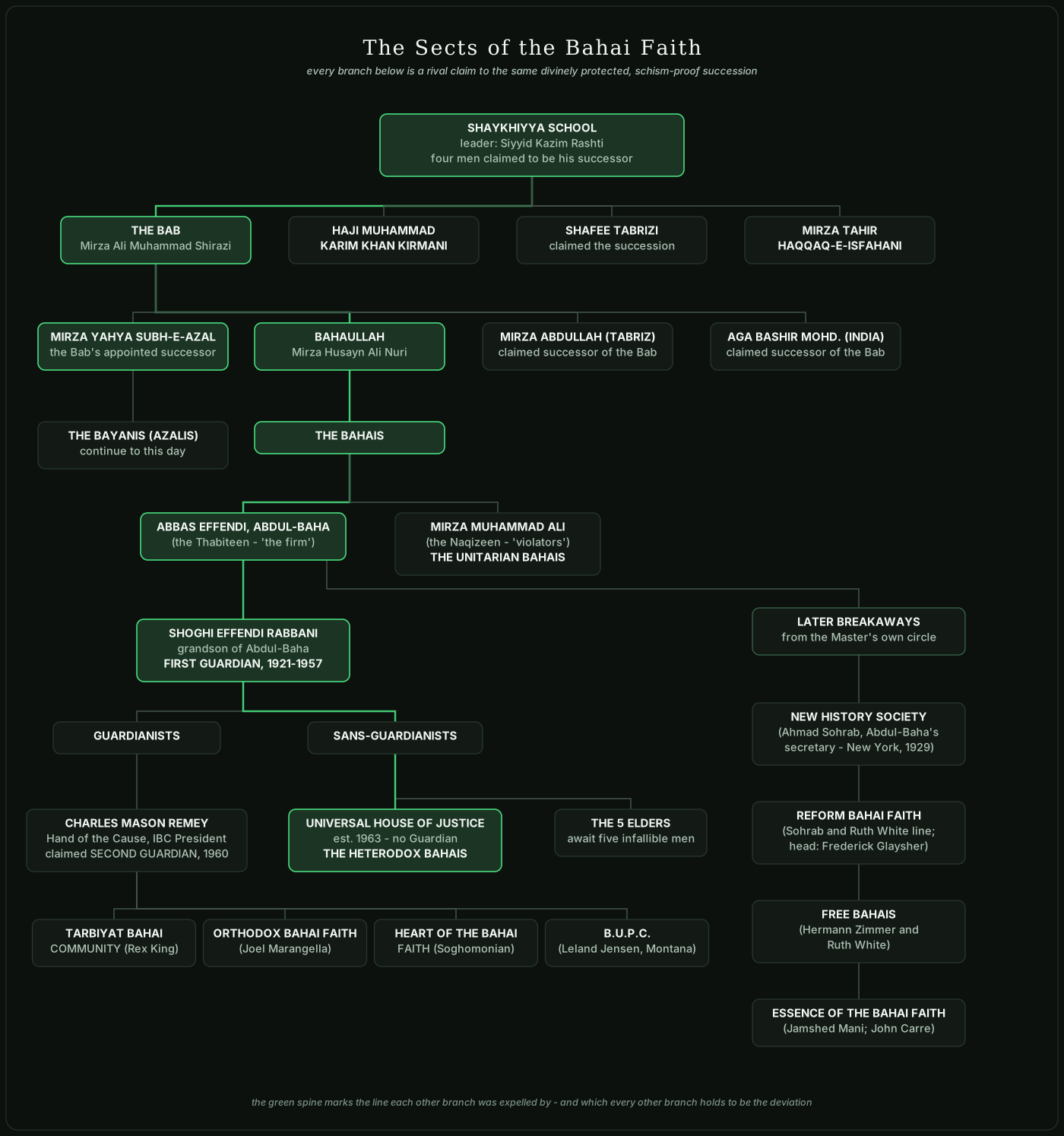
The family tree of the "unbreakable" Covenant - tap the chart to view it full size.
The Principles and the Texts
The Bahai Faith is known to the world almost entirely through its principles - equality, unity, justice, the harmony of science and religion, the free search for truth. The texts that actually govern the faith are far less known, in some cases because they were long untranslated, in others because they are simply not quoted to inquirers. Here they are, principle by principle. Every citation below is from the Bahai Faith's own authoritative scripture.
Start with the very first paragraph of the Most Holy Book, because it sets the tone for everything the marketing omits. The Aqdas opens by declaring that "The first duty prescribed by God for His servants is the recognition of Him Who is the Dayspring of His Revelation" - recognition of Bahaullah - and of whoever withholds that recognition it rules: "whoso is deprived thereof hath gone astray, though he be the author of every righteous deed." (Kitab-i-Aqdas, para. 1). Read it plainly: every honest deed, every act of charity, every life of service by every human being who does not accept Bahaullah is, by the opening law of the Most Holy Book, the deed of one gone astray. This is the faith marketed as the cure for religious exclusivism. Its own first commandment is exclusivism of the strictest kind - the very doctrine it condemns in everyone else, installed at paragraph one.
The equality of men and women - and the institutions and laws
The supreme governing body of the faith, the Universal House of Justice, is permanently closed to women - not by custom, but by what the institution itself calls divine law. In its own official statement on the question, the House declares that its membership, "according to the explicit text of the Law of God, is confined to men", and formulates the principle thus: "women are the equals of men in all rights save only that of membership on the Universal House of Justice." (The Universal House of Justice, letter of 31 May 1988). Sit with that sentence, written in defense of the faith by its highest authority: equal in all rights, except the right to sit in the seat of supreme authority. That is not a footnote to equality. It is the definition of inequality - the one exception that swallows the rule, since the excepted body is precisely the one that rules all the others. The official explanation, standing since Abdul-Baha, is that the reason will one day be evident "as clearly as the sun at high noon" (Abdul-Baha, as cited in that same letter). A promise of a reason is not a reason; the promise is over a century old, and the sun in question has yet to rise. Nor was the exclusion a late development: in the faith's early American years, when women asked to serve on the houses of justice, the ruling from Abdul-Baha confined that service to men (Tablet to Corinne True, 1902; Selections from the Writings of Abdul-Baha, pp. 79-80). The first religion in history to proclaim the equality of the sexes as revealed principle is governed, at its summit, by an all-male body as a matter of - their words - the explicit text of the Law of God.
The law of inheritance in the Kitab-i-Aqdas completes the picture. For a believer who dies intestate, the Aqdas (para. 20, with its appended Questions and Answers) fixes the estate in 2,520 shares: 540 to the children, 480 to the wife, 420 to the father, 360 to the mother, 300 to the brothers, 240 to the sisters - and 180 to the deceased's teachers. The father outranks the mother; the brothers outrank the sisters; and the family residence and the personal clothing of the deceased pass specifically to the male offspring. The appended rulings go further: "Any heir, from whichever category of inheritors, who is outside the Faith of God is accounted as non-existent and doth not inherit." (Kitab-i-Aqdas, Questions and Answers, no. 34). A believer's own child, if not a Bahai, is "accounted as non-existent" at the parent's estate - disinherited by scripture for the crime of a different conscience, in the faith of independent investigation and the oneness of mankind. This is not seventh-century legislation being judged by modern lights; it is the book Bahais date to 1873 and call the charter of the age of human maturity - the age, they tell us, whose hallmark is the equality of men and women.
The pattern runs through the ritual law as well, and one juxtaposition makes it unanswerable. The Aqdas proudly announces (paragraph 75) that God "abolished the concept of 'uncleanliness,' whereby divers things and peoples have been held to be impure", and it even singles out one bodily substance for explicit rehabilitation (paragraph 74): "God hath decreed, in token of His mercy unto His creatures, that semen is not unclean." Yet paragraph 13 rules: "God hath exempted women who are in their courses from obligatory prayer and fasting" - excused from the two central obligations of the faith and assigned, instead, ablutions and a verse of glorification repeated ninety-five times a day. So the book that abolished impurity, and that took care to certify the cleanness of the male emission by name, still writes the female cycle out of the core acts of worship. If uncleanness is truly abolished, the exemption has no basis; if the exemption has a basis, uncleanness was not abolished. Either way, one sex's biology received a certificate and the other's received an exclusion - in the scripture of the age of equality.
The Aqdas's law of travel (paragraph 67) completes the domestic picture: a husband who intends to journey "must fix for his wife a time when he shall return home", and should he fail to return, she is to wait nine months before she may remarry. The legislation contemplates one traveler and one waiter, and assigns the roles by sex - he journeys, she waits. This is not a relic misread; it is the plain architecture of the marriage law in the book for the next thousand years.
The oneness of humanity - and the penal code
The Kitab-i-Aqdas legislates, for the age of universal peace, the following:
Kitab-i-Aqdas, paragraph 62 - "Should anyone intentionally destroy a house by fire, him also shall ye burn; should anyone deliberately take another's life, him also shall ye put to death."
Read the first clause again. The crime is the destruction of a house - property. The sentence is to be burned alive. A human life, extinguished by fire, in payment for a building: life in lieu of material loss, with the method of execution selected for maximal agony. This from the pen that wrote "the earth is but one country"; this in the book of which the same author declares, "the Book itself is the unerring Balance established amongst men" (Kitab-i-Aqdas, para. 99). The standard Bahai reply is that a future society will decide the details, that imprisonment is mentioned as an alternative elsewhere, that the law is not yet in force. Every clause of that defense concedes the point: the unerring Balance, weighed by its own community, is found unusable as written. A law that its own faithful must indefinitely suspend on humanitarian grounds is not the perfected legislation of the age of maturity. It is a nineteenth-century text its inheritors are quietly embarrassed by - and "unerring" is their word for it, not ours.
The arsonist is not alone in the penal chapter. For the thief, paragraph 45 legislates: "Exile and imprisonment are decreed for the thief, and, on the third offence, place ye a mark upon his brow so that, thus identified, he may not be accepted in the cities of God and His countries." A permanent brand on the forehead - a human being marked for life, disqualified from residence among the people of God everywhere on earth, with no distinction drawn between the embezzler and the starving. Branding criminals was the practice of ancient empires and slave codes; here it is legislated, in 1873, as the mercy of the Lord of the new age of maturity. Whatever this is, it is not the moral summit of human civilization. It is the penal imagination of the era and region in which the book was actually written - which is the whole point.
The faith's law of marriage tells the same story in miniature, across three generations of infallible authority. The Aqdas permits a man two wives (para. 63). Abdul-Baha then reinterpreted the permission into a prohibition - monogamy only. And Bahaullah himself, author of the two-wife limit, had three. Three positions - three, two, one - each carrying divine authority, within a single family, inside fifty years. The unerring Balance cannot weigh even its author's household.
The oneness of mankind - and the Exemplar's published pages
The teaching Bahais are proudest of is the oneness of mankind and the elimination of racial prejudice. What follows is quoted, with references, from the faith's own published and authorized books - the recorded words of Abdul-Baha, whom Bahais revere as the perfect Exemplar and infallible interpreter of the faith. These are not leaked documents. Their own publishing trusts have kept them in print for a century, and their official online library carries them today.
On the peoples of Africa: "If a child is left in its natural state and deprived of education, there is no doubt that it will grow up in ignorance and illiteracy, its mental faculties dulled and dimmed; in fact, it will become like an animal. This is evident among the savages of central Africa, who are scarcely higher than the beast in mental development." (The Promulgation of Universal Peace, talk of 2 September 1912, Montreal). And again: "A man who has not had a spiritual education is a brute. Like the savages of Africa, whose actions, habits and morals are purely sensual, they act according to the demands of nature to such a degree that they rend and eat one another." (Some Answered Questions, ch. 29 of the original authorized translation, pp. 118-119).
To the black believers of America in 1912 - the America of segregation and lynch law - the Exemplar taught: "The black man must ever be grateful to the white man, for he has manifested great courage and self-sacrifice in behalf of the black race... Therefore, always show forth your gratitude to the white man." (The Promulgation of Universal Peace, talk of 11 May 1912, New York, pp. 111-113). And of his own nation he wrote: "It should not be imagined that the people of Persia are inherently deficient in intelligence... On the contrary, they have always excelled all other peoples in endowments conferred by birth." (The Secret of Divine Civilization, p. 10).
Assemble what these pages actually teach: the Africans are "savages" who "rend and eat one another," standing "scarcely higher than the beast"; the black believer owes perpetual gratitude to the white man; and one people on earth - the author's own - has "always excelled all other peoples" in the endowments of birth. The Persian-language collections of his talks, published by the faith's own National Assembly of Iran and never officially translated, are documented to go coarser still - photographic reproductions of the printed pages circulate, describing the inhabitants of black Africa as like animals "and even lower" (Khatabat, vol. 2, pp. 236-237), with one passage rendered as calling them cows created in the shape of human beings (Khatabat, p. 203, from the Persian). The customary defense is that such statements merely reflect the ordinary assumptions of the nineteenth century. They do - and that concedes the whole case. The ordinary assumptions of his century are precisely what an infallible interpreter of God's word, the appointed Exemplar of the religion of racial oneness, exists to stand above. A man who absorbed the prejudices of his time and place is a man of his time and place, and nothing more.
The Most Holy Book completes the record. Its slavery law reads: "It is forbidden you to trade in slaves, be they men or women." (Kitab-i-Aqdas, para. 72). To trade - the commerce is named and banned; the owning is not. And the faith's own historical publications document enslaved Africans serving in the households of both the Bab and Bahaullah (recorded in the Bahai-published study Black Pearls: Servants in the Households of the Bab and Bahaullah). A religion announcing the end of all prejudice was founded in households attended by enslaved black servants, wrote a slavery law that stopped at the marketplace, and left on its Exemplar's published pages the sentences quoted above. This is their own record, in their own books, awaiting any inquirer who reads past the pamphlets.
The scales of justice - and the treasury behind them
Read the Most Holy Book with an accountant's eye, and a pattern emerges that deserves more attention than it gets: with striking regularity, the money flows to the institution doing the legislating.
The tax first: Huququllah, the Right of God - nineteen percent of one's accumulated wealth, owed to the head of the faith (Kitab-i-Aqdas, para. 97). Then the penal revenue. Paragraph 49: "God hath imposed a fine on every adulterer and adulteress, to be paid to the House of Justice: nine mithqals of gold, to be doubled if they should repeat the offense." Note the arrangement in its two remarkable parts. First, the punishment for adultery is a payment to the religious administration - sin converted into revenue, at a posted price. Second, the tariff doubles with each repetition - a recurring-offender pricing schedule, eighteen mithqals for the second offense, thirty-six for the third, the House of Justice collecting at every step. And lest the fines of other offenses escape the net, paragraph 52 provides: "We have decreed that a third part of all fines shall go to the Seat of Justice." A third of all fines, forever, to the governing body - written into scripture by the founder of that body's authority.
Even the marriage law carries a price list with a class structure. Paragraph 66: "No marriage may be contracted without payment of a dowry, which hath been fixed for city dwellers at nineteen mithqals of pure gold" - and for village dwellers, the same figure in silver. Gold for the townsman, silver for the villager: the Most Holy Book of the age of the oneness of mankind grades the value of a marriage covenant by the postal address of the groom, at roughly a fifteen-fold difference in the metal's worth. Recall that the estate of every intestate believer already reserves a share for the deceased's teachers, and that heirless shares route to the House of Justice. None of this is hostile reconstruction; every figure is in the authorized text. A book of divine justice may legislate about money - but when the fines, the tithes, the estate shares and the thirds converge so faithfully on the lawgiver's own institution, a reader is entitled to notice whose scales these are.
The language of loving-kindness - in the founders' own pens
The Bahai writings command a beautiful ethic of speech. The Aqdas, paragraph 19: "Ye have been forbidden to commit murder or adultery, or to engage in backbiting or calumny; shun ye, then, what hath been prohibited in the holy Books and Tablets." The Will and Testament of Abdul-Baha instructs the believers: "Consort with all the peoples, kindreds and religions of the world with the utmost truthfulness, uprightness, faithfulness, kindliness, goodwill and friendliness... should they poison your lives, sweeten their souls; should they inflict a wound upon you, be a salve to their sores." (Will and Testament of Abdul-Baha, part one).
Now listen to the same pens when the subject is their own relatives. The document containing the "sweeten their souls" instruction is the document that brands a brother "the Centre of Sedition, the Prime Mover of mischief" and orders a thousandfold shunning of him and of anyone who so much as privately contacts him. His Persian-language letters, published by the faith and never officially rendered into English, are reported in one circulated translation to describe those brothers as arrogant fools, dung beetles ecstatic at the smell of garbage, lowly earthworms, and bats of darkness (Makatib of Abdul-Baha, Egypt edition, vol. 1, pp. 442-443). And the tradition continued. In December 1949 the Guardian of the faith announced the expulsion of his own brother in a cable published to the community in the faith's official news organ - it reads, in part: "Faithless brother Hussein, already abased through dishonorable conduct over period (of) years followed by association with Covenant-breakers (in) Holy Land and efforts (to) undermine Guardian's position, recently further demeaned himself through marriage under obscure circumstances with lowborn Christian girl (in) Europe." (Shoghi Effendi, cablegram of December 1949, published in Bahai News, March 1950).
Weigh each phrase against the advertised principles. "Lowborn" - caste contempt for a human being's birth, from the world head of the faith of the oneness of mankind. "Christian girl" - her religion itemized as an element of the disgrace, by the appointed Guardian of the faith of the oneness of religion. A private family rupture would prove nothing about a religion; every family has its griefs. But this was not private: it was an official act of religious governance, cabled to the world, printed in the community's own bulletin, by the one man on earth Bahais held to be under unerring divine guidance - and it is backbiting and calumny by the Aqdas's own definition, published against a brother whose offense was his choice of wife. The faith that tells its members to sweeten the souls of those who poison their lives could not extend plain courtesy to its own founding family. When the standard and the record part company this widely, the standard is a banner, not a law.
The independent investigation of truth - and the guarded library
The first principle every inquirer hears is that each soul must investigate truth independently, free of clergy and inherited dogma. Now the record of the texts themselves. The Kitab-i-Aqdas - the Most Holy Book, the charter of the dispensation - was written in 1873 and was not given an authorized English translation until 1992: one hundred and nineteen years in which generations of Western believers lived and died under a law they could not read. The Bayan - the scripture of the Bab, the faith's founding Manifestation - has never received an official translation, to this day. The majority of Bahaullah's thousands of tablets remain unpublished in any language. Believers who wish to publish about their faith submit their work to institutional review before it may appear. Dissenters are shunned by name. And the previous scripture of the chain, by the Aqdas's own acknowledgment, commanded the faithful to destroy every book on earth save those defending the Cause. At every link - Bab, Bahaullah, Abdul-Baha, Guardian, House - the pattern repeats: the principle of free investigation is preached to those outside and rationed to those within. The withholding is stranger still beside the production claims: Bahaullah's revelation is said to have flowed at the rate of "the equivalent of a thousand verses" "within the space of an hour" (recorded in Shoghi Effendi's official history, God Passes By) - a torrent of divine text, the bulk of which the divine institutions have never let anyone read. The pattern reaches the classroom too: the Persian collections record Abdul-Baha ruling that "it is absolutely prohibited for the children of the friends to go to the schools of others" (Makatib, vol. 5, p. 170, from the Persian) - while Shoghi Effendi himself was educated at a Jesuit college in Haifa and the Syrian Protestant College in Beirut (recorded in his official biography, The Priceless Pearl, pp. 16-17). And it reaches geography: by standing policy confirmed in writing by the Universal House of Justice, "Bahais do not teach the Faith in Israel", and an Israeli who asks is to be told "that the Faith is not taught in Israel and that there is no Bahai community there" (letters of the Universal House of Justice, 20 October 1994 and 23 July 1995). The universal religion for all mankind may not be taught in the one country where its world center, its shrines, and its qiblih stand. A faith confident of its evidences does not keep its founding books untranslated for a century, forbid its children the world's schools, and switch itself off at its own front door; it prints its books in every language and dares the world to read them. We know this because there is a scripture that does exactly that:
[15:9] Absolutely, we have revealed the reminder, and, absolutely, we will preserve it.
Worship God alone - and the direction of prayer
The Bahai writings insist that God is an unknowable essence and that the Manifestations are but mirrors. Now, from the Kitab-i-Aqdas: the believer's daily obligatory prayer must be performed facing the Qiblih - which the Aqdas defines as the person of Bahaullah himself, "the Court of My Most Holy Presence", wherever he happened to reside; and after his death, the text directs, "turn your faces towards the Spot that We have ordained" - his tomb (Kitab-i-Aqdas, para. 6). And so it is: every day, across the world, Bahais turn in ritual prayer toward a shrine near Akka containing the body of Mirza Husayn-Ali Nuri. During his lifetime the direction of worship moved when he moved - Baghdad, Adrianople, Akka - the compass of the religion pointing not at anything eternal but at the current lodging of its founder. A faith may protest that the direction is symbolic and the worship belongs to God; the Quran had already answered the arrangement thirteen centuries earlier, in one line:
[72:18] The places of worship belong to GOD; do not call on anyone else beside GOD.
The harmony of science and religion - and the copper that ripens into gold
The principle of the harmony of science and religion is tested against the Kitab-i-Iqan, the faith's foremost doctrinal work, where Bahaullah writes (Kitab-i-Iqan, p. 156 of the authorized translation): "consider the substance of copper. Were it to be protected in its own mine from becoming solidified, it would, within the space of seventy years, attain to the state of gold." This is medieval alchemy - the doctrine that base metals mature into gold in the womb of the earth - stated as fact, as the premise of an argument, by a Manifestation writing in 1862, a full century after chemistry had buried it. The Bahai defense is that the passage is a spiritual metaphor. But the sentence is offered as an illustration from nature, and an illustration from nature illustrates only if the nature is true; a metaphor built on a false fact is simply a false fact with a moral attached. The harmony of science and religion is a fine principle. Copper does not become gold in seventy years, whatever book says otherwise - and the book that says otherwise is the one this faith calls certitude.
Nor is the Iqan alone. Abdul-Baha's Some Answered Questions - table talks published with his approval and treated as authoritative doctrine - devotes entire chapters to refuting the evolution of man from other species. Man, he teaches there, "has remained a distinct essence - that is, the human species - from the beginning"; the changes of form over the ages "do not preclude the originality of the species" (Some Answered Questions, chapters on evolution and the modification of species) - man was always man, a separate original kind, merely developing as an embryo develops. This is species fixism, argued at length, against Darwin by name and against what has since become the single best-attested framework in the life sciences. The same collection explains light as "the expression of the vibrations of the etheric matter" (Some Answered Questions, ch. 16 of the original translation) - the luminiferous ether, a substance nineteenth-century physics postulated and twentieth-century physics discarded. A letter of his preserved in the faith's own compilations even teaches that the four canine teeth of man are "designed for breaking hard shells, such as those of almonds" (compiled in Lights of Guidance, no. 1007) - dentistry has yet to concur. The official responses today argue that the ether passages meant only an "intellectual reality" rather than a physical one, and that the evolution chapters concern spiritual originality rather than biology. Read the chapters; they argue from embryos, elements, fossils of form - the vocabulary of natural science, deployed with the confidence of one settling a scientific question. The principle of the harmony of science and religion, in the mouths of these authors, turns out to mean: religion agrees with the science of 1875, permanently. Where the science moved, the infallible text did not - and the harmony is now maintained by reinterpreting the text, which is the very move the harmony principle was supposed to make unnecessary.
The Sum of It
Step back and view the whole. A chain of claims that begins in a private dream of drinking blood, advanced by ordered concealment, and publicly renounced from a mosque pulpit by its own claimant when the pressure came. A founding scripture deliberately built on nineteen that broke off at nine, never finished and never translated - a scripture that banned questions and decreed the destruction of books, by the repeal notices of its own successor. A succession from the Bab that his own appointed successor rejected, resolved by schism and blood in the founding generation of the religion of unity - a religion that has since divided at every generation, its splinters led by the founders' own successor, son, secretary and council president, its main body twice told by American courts that it does not own the name "Bahai." A law-book that brands any claimant within a thousand years a lying impostor, written by a claimant who came nineteen years after the last one. A prophetic record of missed dates repaired with reinterpretation - and, in one documented case, with an eraser, the failed prophecy rewritten in the faith's own textbook after history returned its verdict. A divine Covenant, advertised as schism-proof, in which every appointed link snapped - the Bab's successor rejected the promised one, Bahaullah's designated second became the faith's arch-villain, the everlasting Guardianship died with its first Guardian, who appointed no one - leaving the faith governed by a body its own constitution does not recognize and its own Guardian pre-declared "mutilated." And a set of luminous principles - equality, free inquiry, science, the oneness of mankind - each one contradicted in the plain text of the faith's own most holy books: a supreme body closed to women by "the explicit text of the Law of God"; thieves branded on the brow and arsonists burned; fines, tithes and dowries flowing by statute to the lawgiver's own treasury; testaments that command believers to sweeten the souls of their poisoners while cursing brothers and their "lowborn" brides; an Exemplar whose published pages rank Africans "scarcely higher than the beast" and his own nation first in the endowments of birth; a library of founding scripture kept untranslated from the very believers commanded to investigate truth independently; and a science settled permanently at the year 1875.
None of this required a hostile witness. Nearly every document cited is Bahai scripture or Bahai publishing history, and what is not comes from the public record of courts and scholars; every event is one no informed Bahai disputes; every argument is a matter of holding their texts against their claims and letting the two meet. This is the same scale this site applies to every claimant - to the hadith corpus, to Mirza Ghulam Ahmad, to each self-announced messenger of our own day - and it is the scale the Quran demands: consistency, fulfillment, evidence. The test is not rhetorical. The Quran passes it in the only way that matters - by remaining, fourteen centuries on, exactly what it was, sealed under a mathematical structure that turns every reader into an auditor:
[2:23] If you have any doubt regarding what we revealed to our servant, then produce one sura like these, and call upon your own witnesses against GOD, if you are truthful.
[74:35] This is one of the great miracles.
To the Bahai reader who has come this far: nothing in these pages doubts your sincerity, and nothing here asks you to abandon what first drew you - the longing for one human family under one God, for peace, for a faith that fears no question. This article asks only that the fear of no question be taken seriously, including these questions. The unity of mankind under God alone is not a nineteenth-century invention awaiting a Persian nobleman's seal; it is the ancient, standing call of the scripture that was never edited, never broken, and never needed a guardian it could lose. Weigh the evidence. Count for yourself. The Balance that does not err has been in the world all along.
Peace be upon you, and may God bless your day.