The Two False Verses (9:128-129)
Six independent tests. One pair of verses fails every one of them. No other pair in the Quran fails a single one.
I. What Is Being Claimed, and Why It Is Not Reckless
God did not promise to protect every sheet of paper printed by human hands. He promised to protect the Quran - the revelation itself: "Absolutely, we have revealed the reminder, and, absolutely, we will preserve it." (15:9) The place of that preservation is named, and it is not a printing press: "Indeed, it is a glorious Quran. In a preserved master tablet." (85:21-22) That distinction matters, because the record of God's earlier scriptures is a record of human tampering - the son of the sacrifice quietly changed from one brother to another in Genesis 22 is only the most famous case. The Quran is not exempt from the attempt; it is exempt from the attempt succeeding undetected, because it alone was sent with a built-in guard that makes an addition visible. This article is about one addition - the last two verses of Sura 9 - and the claim is precise: they are the work of a later hand, and the evidence for it is not a single argument that can be waved away, but the convergence of six unrelated ones. A verse may look odd on one axis by chance. It does not look odd on six axes by chance.
II. The Verses in Question
In the standard mushaf, Sura 9 (al-Tawbah, "Repentance") closes with these two verses:
[9:128] "A messenger has come to you from among you who is grieved by what you endured of hardship, and who cares about you, and is ra'oof (benevolent) and raheem (merciful) towards the believers."
[9:129] "If they turn away, then say, 'God is sufficient for me, there is no god except He. I put my trust in Him. He is the Lord of the great throne.'"
Read on their own, they are gentle and pious - which is exactly why they were never questioned by the casual reader, and exactly what a forger honoring the prophet would produce. But the Quran is not read on its own; it is read against itself, and against the sura it sits in. On that reading, this soft couplet lands at the end of the most militant chapter in the Book - a sura that opens not with mercy but with an ultimatum, "An ultimatum is herein issued from GOD and His messenger to the idol worshipers" (9:1), and spends 127 verses on treaties, warfare, the exposure of hypocrites, and disassociation. In Rashad Khalifa's translation the sura ends at verse 127, and the header placed over that final verse states the matter without euphemism: "A Historical Crime Unveiled: Tampering With the Word of God."
III. First Test: The Seam You Can Hear
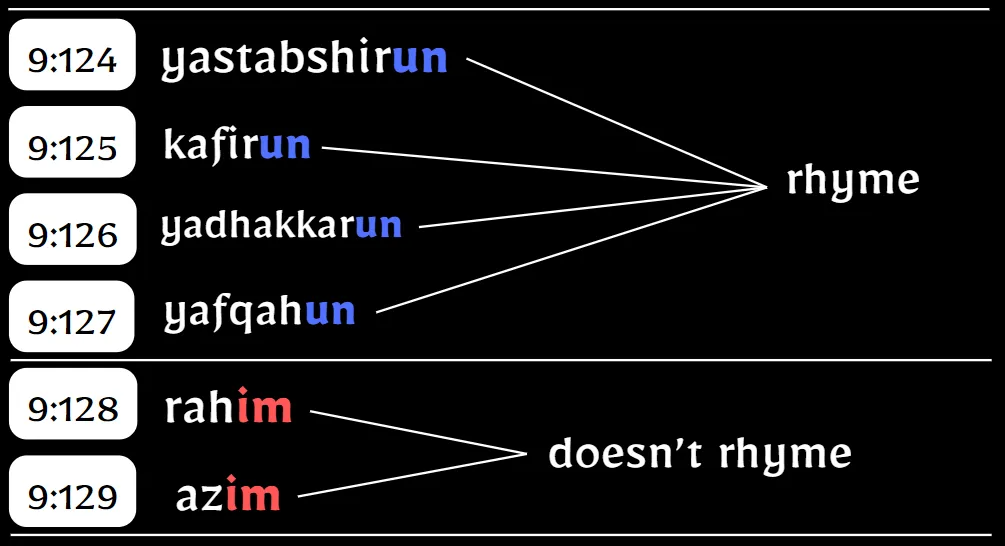
Every sura of the Quran holds a rhyme at the end of its verses - the fasila - and a reciter feels its cadence the way a listener feels the meter of a poem. The close of Sura 9 settles into a single, insistent rhyme and holds it for nine verses in a row. Read the ending sound of each:
9:119 al-sadiqin · 9:120 al-muhsinin · 9:121 ya'malun · 9:122 yahdharun · 9:123 al-muttaqin · 9:124 yastabshirun · 9:125 kafirun · 9:126 yadhakkarun · 9:127 yafqahun
Nine consecutive verses locked on the long-vowel-plus-nun rhyme (-in / -un) - the ear is fully inside that cadence when the sura ends. Now the two appended verses:
9:128 rahim · 9:129 azim
The rhyme drops off a cliff - from the nun ending to a mim ending. This is not a subtle scholarly nicety; it is audible to anyone who recites the passage aloud, which is why avid readers of the Arabic have long remarked that the two verses "stick out like a sore thumb." A forger can copy vocabulary and piety. What he cannot easily do is reproduce the exact rhyme a passage was already committed to - and here he did not even try.
IV. Second Test: A Servant Given the Names of God
Verse 128 calls the messenger ra'oof (compassionate) and raheem (merciful). These are not ordinary adjectives in the Quran; they are among God's own names. Search the entire Book and ra'oof, the singular divine name, is applied to one being only - God - in every one of its ten occurrences: "GOD is Compassionate towards the people, Most Merciful" (2:143), "Your Lord is Compassionate, Most Merciful" (16:7), and so on through 2:207, 3:30, 9:117, 16:47, 22:65, 24:20, 57:9, 59:10. The name Raheem, in the singular, is likewise God's alone - so exalted that it, with Rahman, was chosen to stand in the opening formula of the Book itself. The one time the Quran lets believers share in this quality, it changes the grammar to keep the line between Creator and creature intact: 48:29 calls the believers ruhama' - the plural, "compassionate amongst themselves" - never the singular name that belongs to God. Verse 9:128 crosses that line, and it is the single place in the entire Quran where the divine name Raheem is pinned to one human being. That alone should stop a careful reader, because the Quran is emphatic that the line cannot be crossed: "He is Supreme over His creatures" (6:18); "None equals Him" (112:4).
V. Third Test: The Forger's Fingerprint, Eleven Verses Up
Now the detail that turns suspicion into a signature. Where did the two divine names in verse 128 come from? They came from eleven verses earlier, in the same sura. Verse 9:117 describes God:
"GOD has redeemed the prophet... for He is Compassionate (ra'oof) towards them, Most Merciful (raheem)." (9:117)
God is ra'oof raheem toward the believers in 9:117. The messenger is ra'oof raheem toward the believers in 9:128. Same two names, same object of the mercy - the believers - same sura, eleven verses apart. A person composing a verse of praise, wanting words worthy of the prophet, reached for the nearest and highest praise on the page: the two names the sura had just used of God. It is exactly the mistake a human elevator of the prophet would make and exactly the mistake the Author of the Quran would not - for it would mean God described Himself with two of His glorious names and then, eleven verses later, handed the identical pair to one of His servants. The Quran forbids that equivalence in the plainest terms (6:18, 112:4). The proximity is not poetry; it is a fingerprint left at the scene.
VI. Fourth Test: The One Sura Left Without God's Seal
There are 114 suras in the Quran, and 113 of them open with the Basmalah - "In the name of God, Most Gracious, Most Merciful." Exactly one does not: Sura 9. For fourteen centuries this was an unexplained peculiarity. But count the Basmalahs and a design appears. The 113 opening Basmalahs are joined by one more inside the body of the Quran - in Solomon's letter, "It is from Solomon, and it is, 'In the name of GOD, Most Gracious, Most Merciful'" (27:30). That makes 113 + 1 = 114 = 19 x 6. The total resolves to a multiple of nineteen only because Sura 9 is missing its Basmalah. And the two anomalies are not scattered: the sura that lost a Basmalah (9) and the sura that gained an extra one (27) are exactly nineteen suras apart (9, 10, 11 ... 27). The one sura in the Quran that history would tamper with is the one sura God left without His name at its head - as though the seal were deliberately withheld from the document that would be forged, and the count arranged so that the withholding itself keeps the system whole. A missing Basmalah is not an editorial accident. It is a flag planted in advance.
VII. Fifth Test: The Checksum That Predates the Crime
The Basmalah count is one thread of a larger weave. The Quran's text is laced with counts that come out as multiples of nineteen, and Sura 9's ending sits on one of them. Counting the occurrences of the word "God" (Allah) from the opening of the Quran through the end of Sura 9 as it authentically stands yields 1273, which is 19 x 67. Verse 129 contains the word "God" once ("God is sufficient for me"); include the two appended verses and the running total becomes 1274 - and the divisibility by nineteen is gone. The pattern only holds when the two verses are excluded. This is the decisive property of the whole phenomenon: a checksum cannot be forged after the fact by the person adding the data, because he does not control the thousands of other counts it must simultaneously satisfy. The nineteen-based structure was fixed when the Quran was revealed; the two verses were added later; and the structure rejects them. Appendix 24 catalogs a long series of these broken relationships, every one of them falling in the same two verses - but the reader does not need the full ledger. One verified count that breaks on cue, guarding a passage already flagged by a missing seal, is enough to show the mechanism at work.
VIII. Sixth Test: The Testimony of a Single Man
The historical record raised its own alarm about these two verses more than 1300 years before any of the above was noticed. When the Quran was gathered, the working rule was source multiplicity: a verse was written into the official copy only when confirmed by more than one independent witness. Sahih al-Bukhari preserves, in several narrations from Zayd ibn Thabit - the prophet's own scribe entrusted with the collection - that this rule met exactly one exception. He records that he searched, "till I found the last two Verses of Surat at-Tauba with Abi Khuzaima al-Ansari, and I could not find these Verses with anybody other than him" (Bukhari 4989; echoed in 4679, 4986, 7425). Every other verse in the Quran cleared the two-witness bar. These two did not. To seat them anyway, a rule was improvised - that the testimony of this one man "counted as two" - which does not remove the problem; it concedes it, admitting the standard was broken and then bent to fit the result.
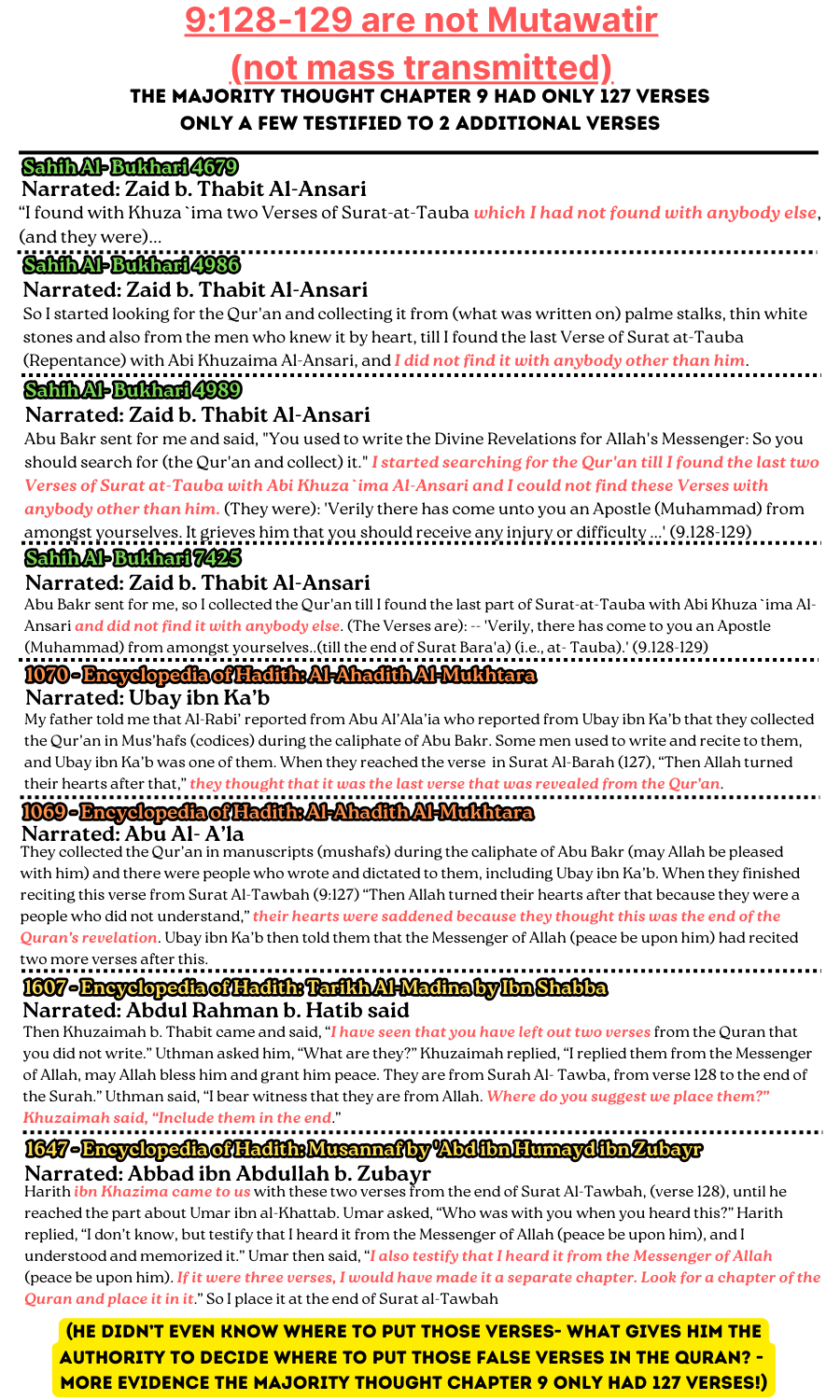
The surrounding reports deepen the picture. Early collections preserve that the community at first believed Sura 9 ended at verse 127 - that when the reciters reached "...people who do not comprehend" (9:127) they took it for the close of the revelation - and that the two extra verses had to be argued in afterward. In one account, when the question arose of where these orphan verses even belonged, it was resolved not by revelation but by suggestion: Khuzayma proposed, "Include them in the end," and Umar reasoned that had there been a third, it would have warranted a chapter of its own. Men deciding, by committee and estimate, where two disputed verses should be slotted into the Book of God is not how a preserved scripture behaves. It is how an interpolation is accommodated.
IX. Medinan, Except the Last Two Verses
The traditional record does not only admit the two verses had a single source; by its own classification it cannot decide when or where they were even revealed. Open a standard mushaf to the heading of Sura 9 and read what is printed there in the frame above the text: the sura is Medinan - "except the last two verses, which are Meccan" - 129 verses, revealed after al-Anfal. Take that heading at face value and it collapses on itself. A "Meccan" revelation, by the very definition that draws the line between the two categories, is one that came down before the emigration to Medina. But al-Tawbah is agreed to be among the last suras revealed, years deep into the Medinan period - and its two closing verses were found, as Section VIII showed, only with Abu Khuzayma, an Ansari: a Medinan. A sura cannot open in Medina in the final years of the mission and then close in the Mecca the prophet had left a decade earlier; no revelation was descending in Mecca after he emigrated. The label is not evidence that the verses are genuinely Meccan - it is evidence that the tradition could not find a real place for them in the timeline at all. That is precisely the footprint an interpolation leaves: a fragment with no true coordinates in the revelation, which the classifiers could only shelve under a heading that contradicts the very chapter it closes.

The mushaf's own heading for Sura 9: Medinan - "except the last two verses, which are Meccan" - 129 verses, revealed after al-Anfal.
X. The Copy That Had to Be Destroyed
There is a final piece of history that a preserved-text account cannot comfortably explain. The Quran written down during the prophet's life, and the master copy compiled immediately after, did not survive. The early sources record that Marwan ibn al-Hakam, once he held power in Medina, obtained the original compiled copy and had it destroyed, "fearing it might become the cause of new disputes" (Ahmad von Denffer, Ulum al-Qur'an, Islamic Foundation, p. 56). Two questions follow, and neither has a comfortable answer for the traditional view. If the original was identical to the copies already in circulation, why destroy it at all? And if it was identical, how could preserving it possibly cause "new disputes"? An identical copy is a confirmation, not a threat. A copy is only dangerous to circulate when it differs from what is circulating - when, laid beside the standardized text, it would show something missing, or something added. The destruction of the one document that could have settled the question is not neutral; it is the behavior of parties with something to hide about the contents.
One early narration speaks almost too directly to the point. Al-Suyuti, in al-Itqan fi Ulum al-Qur'an, records - through Ibn al-Durays's Fada'il al-Qur'an, from Ikrimah - that after the pledge of allegiance to Abu Bakr, Ali ibn Abi Talib kept to his house. Asked why, he is reported to have answered: "I saw the Book of God being added to (ra'aytu kitab Allah yuzadu fih), so I resolved not to put on my cloak except for prayer until I had gathered it." Abu Bakr's reply was not a denial but an endorsement: "How excellent is what you have seen." A companion of the first rank, stating plainly that he saw the Book "being added to," with the caliph agreeing rather than correcting him, is as pointed a line as the early record holds on this question.
Kept honest: a different, shorter report of Ali's withdrawal - the cloak-vow related directly from Ibn Sirin, without the "being added to" - was graded weak by Ibn Hajar for a broken chain, and there he read "gathering" as memorizing. That verdict falls on that version; it does not attach to the fuller narration above, which al-Suyuti adduces separately through Ibn al-Durays after quoting Ibn Hajar. And a detail the code's readers tend to notice: in the Islamweb edition of al-Itqan, this passage falls on page 209 - nineteen times eleven.
XI. The Standard Reply, and Why It Does Not Reach
The traditional answer to the single-witness problem is that "found with only one man" means found written with only one man, while the two verses were nonetheless mass-memorized, and so remain authentic by oral transmission. Grant the premise entirely; it still rescues only one of the six tests. Mass memorization does not explain why the verses break a rhyme the sura held for nine straight lines. It does not explain why they hand two of God's exclusive names to a servant. It does not explain why those two names were sitting eleven verses above, freshly used of God. It does not explain why the count of "God" divides by nineteen precisely when the two verses are excluded, or why the one tampered sura is the one sura stripped of its Basmalah while the total still resolves to 19 x 6. Memorization is an answer to a question about transmission; five of the six anomalies are about the text itself, and would remain even if a thousand men had memorized the interpolation. That is the entire force of a convergence argument: each test has its own possible excuse, but the excuses do not overlap, and no single innocent explanation covers the field. The verses are anomalous historically, prosodically, theologically, intratextually, structurally, and mathematically at once - and they are the only two verses in the Quran of which that can be said.
XII. Conclusion
Put the six findings in one line. The two verses (1) shatter a nine-verse rhyme; (2) award a servant the divine names ra'oof and raheem, which the rest of the Quran reserves for God; (3) borrow those very names from a description of God eleven verses earlier; (4) sit at the end of the only sura in the Quran denied its Basmalah - a sura exactly nineteen removed from the one carrying a compensating extra Basmalah; (5) break the running count of the word "God" that otherwise resolves to 19 x 67; and (6) failed, alone among all the Quran's verses, the source-multiplicity test at the moment of collection, in a chapter the community first believed had already ended. And the tradition indicts them twice more from its own mouth: it files them under a heading - "Meccan" - that its own chronology forbids, and it preserves Ali's report that he withdrew to gather the Quran because he "saw the Book of God being added to." Any one of these could be argued away in isolation. Together they do not describe an unusual passage of scripture; they describe an insertion, and they identify it with a precision no other verses in the Book invite. This is not a wound in the Quran's preservation - it is the proof of it. God guaranteed to protect His revelation (15:9), and the protection was never a lock on a printing house; it was a code woven into the text itself, dormant for fourteen centuries, that now lets any honest reader lift out exactly what human hands added and hold up the Quran, once again, as it was revealed. Accordingly, the translation on this site ends Sura 9 where God ended it: at verse 127.